Showing posts with label Kenya. Show all posts

Sunday, January 1, 2012

FIVE WISHES FOR 2012

Would love to see them batting together once again!
There are a lot of things I would love to see happening in 2012... but I have picked out over here, five of them that I dearly wish for:

1. Get That 100 And Then Many More


I hope it happens in a few days time now at Sydney. He's got three there already, and with a Test average of more than 200 at SCG, there's every chance that the 100th ton for Sachin Tendulkar finally arrives there. I wish to see that 100th ton out of the way, and then many more runs and tons from the Little Master in 2012. India will be playing Test cricket against Australia, Sri Lanka, New Zealand and England over the next 12 months... so lets have another special year (like 2010) in 2012 from Sachin Tendulkar!

2. Cheteshwar Pujara Gets Back In

His last appearance in the Indian squad was a year ago... in the Third Test during India's Tour of South Africa. An injury in the IPL caused Cheteshwar Pujara to miss virtually the entire remaining 2011. He made a comeback for Saurashtra mid-way through the Ranji season, but could not get back his form that saw him force his way into the Indian team. With Saurashtra not making it to the quarterfinals (they came very close), and his spot uncertain in the West Zone team, it could be a difficult path for Pujara now. Taking into consideration that Virat Kohli has been given his chance at No. 6 for India in Tests with Rohit Sharma right behind him, Pujara will have to work extremely hard and pray for a little bit of luck along the way. I too will be praying for him... and hope to see him reclaim his spot in India's Test squad very soon!

3. Afghanistan Qualify For The World Twenty20 Championships

The Qualifying Tournament for participation in the World Twenty20 Championships 2012 will be held in United Arab Emirates from 13th to 24th March 2012. A total of 16 teams will fight for the meagre 2 spots open for them in the main event. Realistically, the teams that have a good chance to make it through are Ireland, the Netherlands, Afghanistan, Canada, Kenya and Scotland. I would love to see Afghanistan make it through once again, and participate in their second major global tournament after the 2010 edition of the same. Having followed Afghan cricket closely for the past one year, I find the prospect of Afghanistan in top-flight cricket a very realistic and exciting one!

4. An Exciting U-19 World Cup

The Australian state of Queensland will be hosting the U-19 Cricket World Cup in August 2012. I love watching the U-19 World Cup tournaments for they show up a lot of unknown exciting talent... and not always from the regular cricketing nations. The highest wicket taker in the 2010 edition of the U-19 World Cup in New Zealand was a fast bowler from Papua New Guinea! India is place in arguably the easiest group - Group C - alongside the West Indies, Zimbabwe and Papua New Guinea. I would love to see the Indian juniors perform well and for a lot of young, new and exciting talent to emerge from this tournament.

5. India Gets A Small Measure Of Revenge In November - December

India will be hosting England for 4 Tests at the end of the year in November and December. There is nothing Indian fans would like to see better than a reverse whitewash after the humiliation faced over the English summer of 2011. But one's got to be realistic here... the English cricket team in Test cricket is a fantastic one, and though they are not the most comfortable playing in sub-continental conditions, they can still be a handful. A good pace attack can work in any condition on earth, and the South Africans have shown that admirably in India - twice! But I would love to see India gain some big wins over England during the winter season, and show them why this land came to be known as the Final Frontier!

Saturday, December 31, 2011

THE WORLD CUP REMEMBERED

Just a few hours remain for 2011 to end in my part of the world, and as I looks back at it, the biggest and the most lasting memory remains that of the World Cup 2011 hosted by India, Sri Lanka and Bangladesh from 19th February to 2nd April.

I was planning to write a post on my sporting memories of 2011... but since so many of them were coming from this one particular event, I thought I should first compile my World Cup memories, and then proceed to the sporting memories of 2011. So here are my top 10 memories from the ICC Cricket World Cup 2011:

1. Six And The Celebrations

The obvious first - the six that finished the World Cup! MS Dhoni's strike to win the World Cup finals and the celebrations that followed that hit shall remain memories to last a lifetime... and not just till the end of the year! Those images were magical and I can still recall them vividly - Yuvraj Singh was sobbing uncontrollably, Sachin Tendulkar was being carried around the ground on his teammates' shoulders, Virat Kohli's quote, and the celebrations once MS Dhoni received the trophy from ICC President Sharad Pawar! Cricket had never before been so emotional!

2. Ponting's Last Masterpiece

It was an eagerly anticipated match - the 2nd Quarterfinal between India and Australia at Sardar Patel Stadium, Ahmedabad. And though it came for a losing cause, Ricky Ponting played an innings befitting his calibre! It was virtually a risk-free masterclass century that guided Australia to a competitive first innings score of 259. There were other moments in this match that still remain fresh in my memory - the winning hit by Yuvraj Singh, Suresh Raina's first major contribution in the World Cup, Zaheer Khan's knuckle ball to bowl Michael Hussey, et cetera. But it was that Ponting hundred, eventually his last innings as the captain of Australia, that stands out... for it could scarcely have been any better!

3. Purple-Headed Destroyer

Yes, that is what he did - he destroyed them! Kevin O'Brien came to the crease in Ireland's match against England when his team was 106 for 4 in the 23rd over, and then saw them slump to 111 for 5 in the 25th over. Chasing a target of 328 to win at Bangalore, Ireland had no chance. But no one told this to Kevin O'Brien! He needed just 50 balls to reach his 100... the fastest ever in World Cup history! From the time he came to bat till the time he reached his 100, Ireland scored more than 6 runs in all but 3 overs. And when he got out on a 63-ball 113 with 6 sixes and 13 fours, they were well on their way to cause what was the biggest upset of the event. The Irish veteran Trent Johnston came at the fall of O'Brien's wicket and was present at the end when the win was sealed... just as he'd been there to hit the winning runs against Pakistan four years ago to cause their other big upset in World Cups!

4. #MOAG - Mother Of All Games

When India beat West Indies in the last league match, everyone knew that there was a chance of an India-Pakistan semi-finals at Mohali. And when India beat Australia at Ahmedabad, it was confirmed... a good 6 days before the match! A scramble for tickets, an excited build-up, cricket diplomacy in action, and the day finally arrived! The quality of cricket was not the best, but the occasion and the crowd more than made up for it. Virender Sehwag's attack on Umar Gul, the chances to Sachin Tendulkar en route to 85, Wahab Roaz's ball to get Yuvraj Singh for a golden duck, Suresh Raina's finish, Umar Akmal's attack before getting bowled out to Harbhajan Singh, and then the finish when Misbah-ul-Haq skied a catch to Virat Kohli off Zaheer Khan - some of the moments that still linger from the Mother Of All Games.

5. Muralitharan's Last Match In Sri Lanka

He was carried on his teammates' shoulders around the ground after the semi-finals had been won by Sri Lanka against New Zealand. Arguably Sri Lanka's greatest cricketer ever, Muttiah Muralitharan played his part in the World Cup for Sri Lanka. His final over in international cricket in Sri Lanka was a treat to watch too. Starting from around the wicket, he switched to over the wicket for the last few balls... and on his very last delivery, trapped Scott Styris plumb in front with a massively-turning off-break to finish off his home career in style. What a cricketer!

6. Tied At 338

The match should have been held at Kolkata, but had to be shifted to Bangalore. After a scramble for tickets where a few fans got hurt, the match began and the crowd loved it. Sachin Tendulkar hit a sublime century, which included 5 sixes - 2 of those came off consecutive Graeme Swann deliveries as he started a new spell. It was a message to the English skipper Andrew Strauss that his best bowler means nothing to him! Strauss took that message to heart as he produced his own masterclass innings of 158 after Tim Bresnan had cleaned the Indian tail with a 5-for. It took a beauty from Zaheer Khan to remove Strauss and bring India back into the match with 2 other wickets. Apart from the last ball single that resulted in a tie, there was another moment to remember from this World Cup - Munaf Patel's blinder (no pun intended) to remove Kevin Pietersen and Ian Bell's LBW that wasn't! The infamous 2.50 meter rule denied Yuvraj Singh the wicket of Ian Bell after the field umpire Billy Bowden decided not to overturn his original not out call.

7. Ross Taylor Massacre

He was reprieved - twice! Both times by Kamran Akmal off Shoaib Akhtar's bowling. He made them pay! Ross Taylor, who was not in the best of form, capitalised on those errors by Kamran Akmal (which earned him a lot of jokes on Twitter) and smashed a brilliant century against Pakistan that included some violent hitting at the end. His ferocious hitting resulted in 28 runs being leaked off Shoaib Akhtar's last over and 30 runs off Abdul Razzaq's. Helped by Jacob Oram at the other end, Taylor was ferocious as they compiled an 80-odd run partnership at the speed of light! When Kamran Akmal's turn came to bat, he edged one to Ross Taylor at slip... and the Kiwi was in no mood to return Akmal's favours earlier that day! He grabbed the ball in his hands and the Black Caps celebrated.

8. The Whirlwind Start

It was arguably the best bowling line-up of the World Cup they were facing. The best fast bowler of the present era was to start the proceedings. None of that mattered! Virender Sehwag and Sachin Tendulkar began in a hurry... sprinting away to a 100 in just the 12th over. Tendulkar pulled South Africa's best bowler Dale Steyn for a six behind square leg after Sehwag had typically started the innings with a first-ball boundary. Sehwag scored a 73, Tendulkar 111 and Gautam Gambhir too compiled a 69 before the middle and lower order just gave away, as 9 wickets fell for 29 runs. The fact that India did not even manage to bat the entire 50 overs, falling short by 8 balls, eventually proved to be decisive as South Africa managed to seal a win thanks to Robin Peterson's cameo at the end!

9. Pakistan End Australia's Streak

Pakistan was the last team that had beaten Australia in a World Cup match. That had happened way back in 1999. Since then Australia had been triple World Champions and were looking to continue that streak when they faced Pakistan in their Group A match at Colombo. Umar Gul bowled beautifully and Kamran Akmal managed 3 catches as Australia was bowled out for 176. Then a young Pakistani batsman Asad Shafiq played a mature hand aided by the veteran Younis Khan, followed by another youngster Umar Akmal providing the finishing touches. A big performance was needed to finish off Australia's big unbeaten run in the World Cup... and that is just what Pakistan delivered!

10. England Keep Us Entertained

First, they almost goofed up against the Netherlands. Then they did the inconceivable against India as the match ended in a tie. Then they actually goofed up against the Irish, followed by snatching a win from the jaws of defeat against South Africa. Not satisfied, they then snatched defeat from the jaws of victory against Bangladesh before winning their most convincing win against West Indies - by 18 big runs! Lots of flashes of memory come to mind from England's World Cup campaign - Ryan ten Doeschate's magnificent hundred at Nagpur, some stuff already mentioned above from the India and Ireland matches at Bangalore, Robin Peterson's opening over and Stuart Broad's finish at Chennai, and of course the celebrations after Mahmudullah's and Shafiul Islam's rescue act at Chittagong... England single-handedly kept Group B alive!


There were lots of other moments to remember... Sehwag deciding to bat through the innings and almost doing so in his 175 at the World Cup opener, Chris Mpofu's rocket throw to run out Ricky Ponting that infuriated him to break a TV, Pakistan's tight win over Sri Lanka, Kemar Roach's and Lasith Malinga's hat-tricks against the Netherlands and Kenya respectively, West Indies skittle out Bangladesh for 58, an unknown Canadian teenager Hiral Patel's attack on the Australian pace trio as Canada scored 62 in their first 6 overs, Zimbabweans applauding and shaking hands with Steve Tikolo after the Kenyan legend was dismissed in his final match, and South Africa's choke against New Zealand amongst others.

Monday, August 22, 2011

THE DRAVID DISMISSAL DEBATE

After my previous post on The Dravid Selection Debate, this one is now on the 2nd innings dismissal of Rahul Dravid during the 4th Test at the Oval. It looks like Dravid debates are the fashion for this season! Already, this dismissal has been discussed and dissected all over Twitter and other cricket forums on the internet. Here are my thoughts for what they are worth!

First, let me state very clearly that I did not see the dismissal live and did not even manage to catch a replay till well after the end of day's play. When I did see the replay, I already knew that Dravid had admitted to have edged it. So whether I think there was an edge or not does not matter, because my eyes were always going to be prejudiced after that admission by Dravid. But here's what I do know:

1. Most English commentators and tweeters were of the opinion that they saw a slight deflection from a certain angle, and so Steve Davis was justified in ruling Dravid out.

2. Most Indian commentators and tweeters were of the opinion that they saw no conclusive evidence for Steve Davis to overrule the on-field decision. Since DRS over-ruling works on the basis of conclusive evidence, Davis was not justified.

3. Amongst the neutral, I don't recall many opinions. But I do recall Mike Haysman tweeting that he didn't think there was any conclusive evidence to rule Dravid out.

I think that based on these statements, we can assume that it was a marginal call either way.

Now what I am going to state here has been stated so often already that it's sounding more and more like a cliché, but it has to be mentioned nevertheless. So here it goes again - the DRS was meant to eliminate howlers, and not rule on marginal calls. Where marginal calls are involved, the ground umpire's decision should be taken as the final one. Only when there is overwhelming evidence against the ground umpire's ruling should that decision be overturned.

But while I state all this, lets not forget that the primary aim of the judiciary (and this includes the umpires as well as the technology that has been provided for their aid) is to come to the right decision. And in Dravid's case, the right decision was indeed reached, even though in a wrong way! I remember once an umpire (I think it was Simon Taufel, but I'm not sure!) stated that they would not want their walkie-talkie conversations ever recorded, because often they reach the right decisions in very wrong ways!

So what to make of this debate? Now that we have the benefit of hindsight, in my opinion and strictly in my opinion, I think that the right decision was made and Steve Davis was good to have spotted that faint edge and deviation. In his mind, he was must have been reasonably sure that the edge had been taken, however thin it may have been, and he relayed that decision back to the ground umpire. That's it!

But that's not the end of the story! What I have trouble comprehending is that why are umpires inconsistent in this matter. Some like Billy Bowden prefer to go exactly by the rule book and rule Ian Bell not out in the World Cup match against India even though the evidence overwhelmingly suggested that he should have been Yuvraj Singh's victim! And some like Steve Davis decide to use their initiative and overrule the foundation on which the DRS is based - i.e. the foundation of overwhelming evidence!

I know that the "Ian Bell - Yuvraj Singh - Billy Bowden" example is not quite an exact parallel to this one. And to be honest, I couldn't find any exact parallel. So I will give you the best I could find...

The following video shows the wickets and close calls during the Canada vs. Kenya match in the World Cup 2011. Watch this video from 5:02 onwards - the batsman is Kenyan Steve Tikolo, and the bowler is Canadian Rizwan Cheema.


Now, from what I see here, I think that the edge was clearer here on Steve Tikolo's bat than it was in case of Rahul Dravid at The Oval. I know that it may be a futile exercise to compare, since the situations were different and the umpires involved were different (Bruce Oxenford was the third umpire in the Steve Tikolo case). But the point I'm trying to make is that Oxenford saw it was a marginal call, and though some angles suggested an inside edge, he decided to rule it in favour of the on-field umpire's call. He saw no overwhelming evidence to overrule!

Here, I am not trying to blame Steve Davis in any way. I have already stated that with the benefit of hindsight, we can all agree that the correct decision was made. But the blame lies entirely with ICC's pathetic implementation of the DRS, and its use for marginal calls.

I understand that Bruce Oxenford may not have been as convinced as Steve Davis was to overrule the on-field call, but if I am allowed to judge the third umpires here, I am sure that neither Oxenford nor Davis could have been 100% sure about the edges. Even if Steve Davis was reasonably certain about the edge, I am prepared to bet that he could not have been a 100% confident about his call... simply because it indeed was a very marginal call and the replays could not have been deemed to be 100% conclusive. The varied opinions all over Twitter suggest nothing else.

So what does the ICC have to state? Are the on-field calls to be over-ruled where the third umpires are just reasonably sure about the evidence on offer? Or are they to be over-ruled only when the third umpires are a 100% certain about the error in the on-field decision? Till the ICC does not answer this question clearly and decisively, we will continue to have such vagaries in decision-making even in the future. How this decision might affect the result of this match will be known only tomorrow (and even then, just speculatively), but what it did was that it ended a marathon effort by India's best batsman on this tour on a very sour note!

Well played, Rahul Dravid! Much respect!

Tuesday, June 21, 2011

THE OTHER TIER BATTLE BEGINS

It's not quite Test cricket... but it's the closest a lot of cricketers who deserve to play Test cricket will get to Test cricket!

The ICC Intercontinental Cup is about to begin in less than an hour from now (weather permitting) at Aberdeen, as hosts Scotland will try to overcome a stern challenge of the Netherlands. Scotland finished as the runners-up, losing to Afghanistan in the finals, in previous season (2009-10) of this tournament, which is the only place where the players from Associate and Affiliate nations of the ICC get to play First Class cricket as a part of their national team.The limited-overs leg of the tournament will also run alongside the First Class matches in the 2011-13 season. The first round fixtures are:


I would like to see more teams, in further rounds, do what Kenya and UAE have done - that is, schedule the Limited Overs leg before the four-day First Class match. It will be beneficial for the away team this way. But more than anything else, I am most interested in seeing how Afghanistan copes up with the pressure of expectations this time round.

Afghanistan had a dream run last time, winning 5 matches and drawing 1 to a Zimbabwe XI. They started with a draw against the Zimbabwe XI, and then had a close 1 wicket win over the Netherlands. It was more convincing after that as the three-time defending champions Ireland was beaten by 7 wickets, followed by a 6 wicket win over Canada. Former champions Scotland was then thrashed by 229 runs, and then Kenya too was thrashed by 167 runs. In the finals against the Scots, they prevailed again by 7 wickets, despite being 41 runs in the deficit after the end of the 1st innings in a low-scoring game.

They are on a 6-match winning streak at the moment, and it will be interesting to see if they manage to extend it against Canada early in August. Afghanistan came in playing their first Intercontinental Cup in the last season, and ended up winning it. They were, to an extent, a surprise package last time. But the teams will be better prepared to face them this season, and if any team had made the mistake of taking them lightly last time, it will not happen again!

I hope there is some good quality cricket played in this season of the Intercontinental Cup, and I will definitely be keeping an eye on all the matches and results. If anyone knows where I can get the streamings or the video highlights of these matches, please do let me know.

Monday, March 21, 2011

STEVE TIKOLO

What is common between Marcus Trescothick, Subramanium Badrinath, Brad Hodge and Steve Tikolo? These are men who played less Test cricket in consideration of the respective talents that they had. One quit early, one suffered due to lack of chances, one just could not reproduce his domestic level of performances at the highest level, and one... that last one played for an Associate team!

Here's a look at the numbers generated by Steve Tikolo -


An ODI batting average of 29 does not do justice to him. A First Class batting average of almost 50 is a better indicator. The fact that he is the highest run-scorer in ODI cricket amongst players from Associate teams tells one story, the fact that the person second to him is a good 1003 runs behind him (just about 70% of his total) tells another story!

He's amongst the very few cricketers in the world who have played in 5 World Cups - a feat unachieved by 4 of the top-10 run-scorers in the history of ODI cricket and 7 of the top-10 wicket-takers. At one point in time, he was widely regarded as the best batsman outside of the Test-playing nations. Not without reason!

He
 was the captain when Kenya achieved their cricketing peak in 2003, when they reached the semi-finals of the World Cup 2003. He was present even in this World Cup in 2011, when Kenyan cricket is at its "lowest ebb".

He's been there and done that in respect of Kenyan cricket. He made his ODI debut together with Kenya's debut in a World Cup - back in 1996. He was a part of Kenya's first biggest triumph - the win over West Indies at Pune in that World Cup. He helped Kenya qualify for the next World Cup in 1999, and was their best player there. He led Kenya to a World Cup semi-finals in 2003. When the Kenyan cricket administration fell out with its stakeholders, he led a players' revolt to oust that old regime and took up the effort of rebuilding Kenyan cricket. It was fitting that the name synonymous with Kenyan cricket led them in his final appearance for them at an iconic ground, the Eden Gardens!

The farewell for Steve Tikolo did not go according to the script. But it was heartening to see his opponents (the Zimbabweans) giving him their respectful compliments when he made his final walk back to the pavilion as a Kenyan cricketer! Some players see their greatness celebrated, some others see their greatness hide in pages of history. Steve Tikolo was one of the latter breed of great cricketers, and this is just one of those pages of history!

To end this tribute to Steve Tikolo on a light note, here's what Andy Zaltzman tweeted in reply to me in respect of this Kenyan legend:

All the best for your future ventures, Steve Tikolo!

Thursday, March 17, 2011

FINALLY, AN ICC DECISION WORTH APPRECIATION

For a good part of last two months, I have been getting more and more incensed by some of the decisions taken by ICC. The 10-team World Cup for 2015, defending Billy Bowden's decision of Bell non-LBW, then changing the UDRS rules again, reprimanding William Porterfield for public criticism and not acting against Graeme Swann for his share of public criticism after he had already been fined for swearing at the umpire!

But finally, ICC has taken a decision that I can support. They have decided to drop Ashoka de Silva as an umpire for some of the crucial matches coming up, and relocated him to the dead rubbers remaining. So whereas earlier he was scheduled to stand in England v. West Indies and sit as a third umpire in India v. West Indies matches, he will now stand in the Zimbabwe v. Kenya match and be the fourth official during Ireland v. Netherlands game. (Report)

Ashoka de Silva has given some shockers in this World Cup, and though some of them have been corrected by UDRS, that did not stop him from giving a howler even with the help of UDRS. I have already stated that I consider him the least elite of ICC's Elite Panel of Umpires and frankly, do not find him competent enough to be a part of it.

However, wrapped in this news was something unusual. In that news report, ICC has listed a certain Tyron Wijewardene as the third umpire for the Australia v. Pakistan match. I wonder how does he end up having this job without having officiated in a single match so far in this World Cup. We are coming to the end of league stages and an umpire who has not yet been a part of the World Cup will be officiating as a third umpire in a match between two heavyweights that would potentially decide the group toppers! WEIRD!

Oh well, I am again coming to terms with the fact that there is hardly going to be a single decision taken by the ICC that I will completely agree to! Maybe, I should run it one day... at least, that would help me avoid disagreements with myself!

Friday, February 25, 2011

AUSTRALIA V. NEW ZEALAND - PREVIEW

Following the sad news of the earthquake that rocked Christchurch a couple of days back, the Black Caps will be keen to put one across their Trans - Tasman neighbours and three-time defending champions Australia. A win here may not heal the wounded back home in New Zealand, but it will certainly bring a smile back to their faces. Even if it is a momentary spark of joy for the people affected, for the Kiwi cricketers, I am sure it is worth fighting for!

If more incentive was needed, and these incentives would apply to Australian side too, then there is a Cricket World Cup going on... and a win here will help the team be in a very comfortable position in the race to qualify for the Quarter Finals. Add to it, the Chappell-Hadlee Trophy shall also be decided in this match, since these two teams are not scheduled to compete in another ODI match for the remaining year (unless of course they are to meet again in the Semi Finals or the Finals).

(For the record, this will be the first time that the Chappell-Hadlee Trophy will be contested on a neutral territory.)

The match tomorrow will be played at the Vidarbha Cricket Association Stadium (Jamtha), Nagpur. The previous match here, contested between England and the Netherlands, was a close fought one and saw almost 600 runs being scored. The centurion and Man of the Match in that game, Ryan ten Doeschate of the Netherlands, said that the pace of the wicket was a little slow, but batting was a lot easier once he got used to it. Early consolidation is the key on this wicket while batting.

Considering that New Zealand have already played a warm up match on this ground, it should be slightly easier for them to adjust to the conditions. Having said that, one would be foolish to write the Australians off. They come into the game having a 30-game unbeaten run in World Cup cricket and a comfortable win over the Zimbabweans. While New Zealand's win over Kenya was a lot more thumping, the downside is that it has left their batsmen short of batting practice coming into a match where they will face a pace - charged attack.

Nagpur has seen a bit of unseasonal wet weather of late. There are some chances of the match being rain-affected and played under a cloud cover. If this is so, the pace bowlers on both the sides might get a bit of help. Since it is a day game and will have an early morning 9:30 am start, the side bowling first can expect more help than the other side.

Though the teams might want to stick to their winning combinations, I wonder if Australia might consider using Doug Bollinger in their line up, if the conditions are indeed helpful for the seamers. Johnson and Tait were good against Zimbabwe, but it cannot be denied that both of them are all-or-nothing bowlers. Since both of them had a good outing against Zimbabwe, the law of averages would suggest that one (or even both) of them are due one of their erratic days any time now. Using Bollinger for one of them might not be a bad option. Ponting has also suggested that he will need to use Tait with care so that he lasts through the tournament.

Apart from this, Lee bowled with great control and skill in his practice games as well as against Zimbabwe, and Jason Krejza has shown aggression by flighting the ball and inviting front-foot drives from the batsmen.

For New Zealand, Bennett and Southee had a wonderful first game, while Oram also chipped in with 3 wickets (denying Southee a chance to go for a hat-trick). The interesting bit was that Nathan McCullum's off spin was employed with the new ball. It would be interesting to see if Vettori continues with this tactic. And talking of Vettori in ODIs, he is a master craftsman, and I am sure the Australian batsmen will look to see him off and attack the other bowlers in the game.

The Australian batting looks a lot more settled with Watson, Ponting and Clarke all having a good hit against Zimbabwe. While Guptill has been good for the Kiwis, the others are slightly untested and the likes of Ross Taylor and Jesse Ryder might need to step up big time to see of the Aussies. The Batting Powerplay strategies shall be interesting to watch, since Australia is the team that once again looks stronger in the power-hitting department with the likes of Cameron White, David Hussey and Steve Smith. For all their skills, Franklin, Styris and Vettori at the corresponding batting positions of 5, 6 and 7 just do not inspire as much confidence.

Here are a few numbers that indicate that Australia are the favourites going into this match... but with the emotions that Christchurch will generate and an additional spice in the form of Chappell-Hadlee Trophy also involved, numbers will count for little when the 22 men take the field for their national anthems tomorrow.


It will be hard for Nagpur to provide another entertaining match after the England - Netherlands affair. However, the Chappell-Hadlee Trophy has a history of producing high-scoring encounters, with New Zealand having successfully chased down scores in excess of 330 thrice in the past. Since this one will be played on another batting beauty, I expect no less.


This post has been published as a part of CASTROL CRICKET MATCH PUNDIT HUNT brought to you by BLOGJUNTA If you like this post then FAVE it here and read other entries as well.
Match Pundit Castrol Cricket contest at Blogjunta

Thursday, February 24, 2011

RYAN TEN DOESCHATE

This is coming a little late, but it had to come. With one match, where he scored 119 runs and grabbed 2 wickets against England, Ryan ten Doeschate (popularly called "Tendo" by his teammates) has become a very popular name in a lot of places, including but not restricted to England and India. His performance at Nagpur was the highest score made in ODIs by a player from an Associate team against a Test-playing nation... but more importantly, his performance was a retort to ICC's decision of reducing the number of participants in the next World Cup to 10 teams.

There has been quite an uproar over ICC's decision to discontinue with the practice of inviting the associate and affiliate members to play at One Day International Cricket's biggest event - the ICC Cricket World Cup. In the midst of this uproar, there have also been people who support this decision by the ICC.

Ryan ten Doeschate's performance was a gentle reminder to all of them and the ICC to reconsider their opinions and this decision. Netherlands' and Ireland's performances over the few chances that they have had at the highest level indicates that they are a cut above the rest of the playing field amongst the ICC's associate and affiliate members. Had ICC been a little more proactive in Kenya after 2003, they might also have been a part of this group. If ICC decides to be a little more proactive in Afghanistan, they might become a part of this group in the near future.

I'll do another blog post about this decision by the ICC... but now, I have to talk about Ryan ten Doeschate. A few numbers first for those who are unaware:


Even if one were to say that he's played only 4 ODIs against Test-playing nations, the response shall be that he still manages to average 54 with the bat and 38.67 with the ball. Plus, his numbers in Twenty20s (both Internationals and otherwise), List A matches and more importantly, First Class cricket are also extremely impressive.

His century against England at Nagpur was as calm and composed an innings as you are ever likely to see by any classy batsman while setting up a competitive total for his team to defend. Despite cramping during the latter stages of his innings, he still came on to bowl in order to play his part in defending the total of 292. That Netherlands could not win does not at all indicate that Ryan ten Doeschate did not deserve to be in the winning side.

What endeared me to him the most was his reply when asked whether his century might prompt his native country, South Africa, to recruit him for the next World Cup. "No, I don't think so. I don't think like that. I know this might just be my last World Cup considering next edition will have 10 teams. But I have been playing county cricket (Essex) where I have played with lot of top cricketers. In a few months time, I would be playing in the IPL which will be another big stage." (Source)

He is obviously not interested in playing for an international team other than the Netherlands... for whom he qualified because of his lineage. He was born in South Africa and learnt the intricacies of plying his trade in England with Essex. So I think I might be fair in assuming that playing for Netherlands holds a different value to him... something that I am amazed no one from the media has bothered to ask him about.

In an age where players has switched their commitments at the international level, he comes across as a breath of fresh air. In fact, had Netherlands still possessed the services of their erstwhile pacer Dirk Nannes, they might even have pulled off an upset against England. Not to be... as Dirk Nannes was seen playing for Victoria against New South Wales in Australia just about half a day after Netherlands had lost a close match.

I hope that he and his team do manage to sustain a similar level of performance over the rest of this World Cup... and he keeps giving us, his new fans, more reasons to flaunt his new nickname "Ryan ten Dulkar" all over Twitter.

Wednesday, February 16, 2011

THOUGHTS ON DAY 3 OF WARM UP MATCHES

Zim 244 - 8 in 50 overs, Ire 245 - 6 in 49.3 overs - Ire win by 4 wickets

Ireland had put up a tremendous fight while chasing New Zealand's 300+ score in their first warm up match. This time, they went one better... they chased down Zimbabwe's score with 3 balls to spare.

Ireland got on top early (Zim was 12 - 3 in 8th over)... but Zimbabwe fought 
back first with Taibu's 45 and then with Chigumbura's 103* in just 81 balls. Irish skipper Trent Johnston bowled a superb first spell of 5-2-9-2. While batting, Ireland had partnership stands of 40s for the 2nd, 3rd and 4th wicket. But the 5th wicket stand of 99 between Andre Botha (79) and Kevin O'Brien (62*) was the decisive stand for the match. As they say, a set batsman should see the team through till the end in a run chase... and Kevin O'Brien did that by guiding Ireland to a win with 3 balls to spare. They have issued a warning bell for their Group B opponents!

K
en 263 - 5 in 50 overs, Neth 264 - 8 in 49.1 overs - Neth win by 2 wickets

Kenya batted quite well... with their young 20-year old opener Seren Waters making an unbeaten 126. Rakep Patel scored a 59-ball 64 at the end in a 129-run stand with Waters to see Kenya to a formidable total. But they did not know that the ICC Associate and Affiliate Player of the Year Ryan ten Doeschate had something special in store.

ten Doeschate had done his bit with the ball (10-0-47-2)... but decided to do more. He came in at 87 for to in the 16th over, when the Dutch were starting to lose their early momentum (they had raced to 67 for 0 in 10 overs). Soon with Steve Tikolo running amok, Netherlands slumped to 130 for 7 in 30 overs. Tikolo's gentle off-spin had almost sealed the game then. But the Dutch still had Ryan ten Doeschate at the crease.

In a display that would have pleased even the King-Rescuer VVS Laxman, ten Doeschate upped his scoring rate and though he lost his steady partner Buurman for 29 after an 82 run stand, he remained till the end with an unbeaten 92-ball 98 (3 fours, 4 sixes) to see his team through. The No. 10 Mudassar Bukhari played a small cameo of 20* (15 balls, 2 fours, 1 six) that proved crucial in the end, because when he came in, his side still needed 53 runs of 34 balls. But the man of the moment was definitely Ryan ten Doeschate. Fantasy Team players... are you reading this?

Aus
 217 all out in 47.1 overs, SA 218 - 3 in 44.2 overs - SA win by 7 wickets

Don't be fooled by that 218 for 3 from South Africa. Two of those three (Graeme Smith and Hashim Amla) retired themselves after a 100+ opening stand so that the other batters could have some batting practice. The third wicket, that of Faf du Plessis, was a run out!

Australia got off to a miserable start. Their best form batsman, Shane Watson, was out for a 4th ball duck... lbw to Dale Steyn. Brad Haddin (who did not play the 1st warm up against India) got run out for a duck in the 4th over... Australia was 6 for 2. A 122-run stand between captain Ricky Ponting (55) and vice captain Michael Clarke (79) followed. That would prove to be the only substantial contribution from the Aussie bats for the day... and if I may dare to call it so, their saving grace!

Dale Steyn was the top bowler with 3 wickets for South Africa. In what was a surprise to me, Robin Peterson also managed 3 wickets though he was a tad expensive at over 5.50 an over. Australia really need to brush up their spin-tackling skills!

Smith (65) and Amla (60) put on 131 runs and then retired in that order within 3 overs of each other. Faf Du Plessis was sent at No. 3 to get a bit of practice, but was run out for 12 with South Africa on 157! JP Duminy used this time in the middle to stroke a 47* on his favourite Indian ground at Bangalore. South Africa eased home to a very comfortable win at the end.

WARNING NOTE: Do not count Australia out. They entered the 2007 World Cup in a 5-match losing streak. They won every game in that tournament.

WI
 281 all out in 50 overs, SL 282 - 6 in 47.3 overs - SL win by 4 wickets

West Indies put up a very decent batting performance to post a competitive 281. But they would know that the score should have been a lot bigger. Chris Gayle provided a fiery start with a 38-ball 58, and Darren Bravo's 54 was a perfect foil. However, they was no one to play a big knock and no substantial contributions from the middle order and the lower middle order, where the highest score was 39 by Sarwan. Lasith Malinga and Rangana Herath (3 wickets each) were impressive for Sri Lanka with the ball.

Sri Lanka's chase was built on the back of three main contributors... their three of the four most important batsmen! A ballistic 50-ball 62 from Dilshan followed by calculating knocks of 71 and 55 respectively from Sangakkara and Samaraweera. Despite a minor flutter at the end, where they lost 3 wickets for 28 runs, they reached the target comfortably. Sulieman Benn, with his 3 wickets, was the only West Indian bowler to have numbers worth noticing.

Pak 285 - 9 in 50 overs, Ban 196 all out in 41.4 overs - Pak win by 89 runs

Even though Pakistan put up a very formidable total, it was built on the back of just one big partnership - 152 runs for the 4th wicket between opener Ahmed Shehzad (103) and Misbah-ul-Haq (100). The rest of the batting did not fire as Rubel Hossain and the irrepressible captain Shakib Al Hasan picked 3 wickets each.

When
 the star Bangladeshi opener Tamim Iqbal fell for a golden duck on the first ball of the innings, their chase was all but over. Imrul Kayes and Junaid Siddique got 39 and 38 respectively, but no one could do more than that. Kayes plays a perfect foil for Tamim when Tamim clicks... but Bangladesh really need to find a solution for Kayes' slow batting when Tamim does not fire. It can have an effect of completely stalling the progress of their innings. For Pakistan, the evergreen Abdul Razzaq picked 3 wickets (including Tamim), while Mohammed Hafeez and Abdur Rehman chipped in with 2 each.

Sunday, February 13, 2011

THOUGHTS ON DAY 1 OF WARM UP MATCHES

So the countdown to the start of Cricket World Cup 2011 is on its last stretch... less than a week to go now. The warm up matches have begun, and on the first day, we had 5 of them. Here are a few random thoughts on those matches:

WI 253 - 8 in 50 overs, Ken 192 all out in 45.3 overs - WI win by 61 runs

Ramnaresh Sarwan scored a 125-ball 123 to guide West Indies to a 250+ score, aided by Dwayne Bravo's 56-ball 54 towards the end of their innings. While West Indies will be delighted with Sarwan and Bravo, they need to be wary of the fact that their top order misfired once again. 65 for 4 in the 20th over against Kenya is not a good score... and it was surprising to see that they did not send Kieron Pollard for a hit. He could have done with some practice ahead of the main tournament. But the biggest surprise was that Chris Gayle did not figure in the 12-man team that took part in the warm-up game.

As for Kenya, the veterans Thomas Odoyo and Steve Tikolo were good with the ball. While batting, Collins Obuya made a composed half-century and had he gotten a little more support after his 70-run second wicket stand with Seren Waters, Kenya could have made a serious push towards the target. Though Roach and Russell combined well with the ball, they could not get breakthroughs with the new ball. Kenya has shown promise on the land where they first rose to prominence way back in 1996!

SL 351 - 5 in 50 overs, Neth 195 all out in 47.3 overs - SL win by 156 runs

It was a typical Sri Lankan performance against a minnow, especially on the home ground. The Dutch were soundly thrashed, first by the Sri Lankan batting unit where everyone got starts and then by the bowling performances of Fernando, Perera and Herath. Sri Lanka, however, should be concerned by the fact that none of their batsmen could score a big hundred in batting friendly home conditions, with a run-a-ball 78 from TM Dilshan being their highest score.

Though Tom De Grooth and Bas Zuiderent showed a bit of a fight, Netherlands were never expected to, nor did they, get anywhere close to the target. The only thing that they did well was playing Ajantha Mendis, who had figures of 1 for 40 in 8 overs, that 1 wicket being the 9th to fall... not the figures you'd normally associate with a mystery bowler against a minnow on his home conditions.

Can 112 all out in 37.3 overs, Ban 113 - 1 in 19.2 overs - Ban win by 9 wickets

Bangladesh put in a thoroughly efficient performance to dismantle Canada completely... so efficient it was that they may now be regretting the fact that their batters did not really get a good hit in match conditions before the World Cup. Though Razzaq went wicketless, the other spinners led by skipper Shakib Al Hasan grabbed 6 wickets in a good bowling performance. Except for the skipper Ashish Bagai, no Canadian could muster a solid performance.

While chasing, Tamim Iqbal got the hosts to a flyer... and the match was over within a few blinks. 7 fours and 3 sixes in a 50-ball 69 meant that other than the openers, no one else got any decent batting practice. This was a new Bangladesh side... way different from the one that lost to Canada by 60 runs in the group stages of 2003 World Cup! They have come a long way!

NZ 311 - 6 in 50 overs, Ire 279 all out in 48.2 overs - NZ win by 32 runs

New Zealand must have had a comfortable win in the end, but all credit must go to Ireland for the fight that they put in into their chase. The Kiwis relied on a 134-ball 130 from Martin Guptill and then cameos from Ryder, Taylor, Franklin and Styris to set up a good total... the perfect example of how a batting unit should function! If the Kiwis can manage it against tougher oppositions, they could be well on their way to another good World Cup performance.

While they didn't find much cheer while bowling, the Irish chase was well built. A brilliant and fast opening stand, followed by more good top-order partnerships kept them in the hunt for quite a while. Unfortunately for them, their middle order and lower middle order could not keep up with the challende and they folded in the 49th over. While Porterfield, Stirling, Joyce, Niall O'Brien and Johnston did well with the bat, the bowling performer of the day was the wily Kiwi skipper Daniel Vettori... 4 for 42 in 10 overs, and good support from Kyle Mills. The Kiwis should be overall happy with this performance, especially given the run of performances they have had of late!

Zim 152 all out in 41.5 overs, SA 153 - 2 in 23.3 overs - SA win by 8 wickets

Though Zimbabwe was dismissed for 153 only, it was as unlike a South African bowling performance as you are ever likely to see. I say this because 6 of the wickets were picked by spinners, though Morne Morkel was extremely brilliant and threatening in his 6 overs, 3 for 16. Imran Tahir got a game and got 3 wickets... which makes it interesting to see whether he'll make the cut for the first XI above Johan Botha and Robin Peterson.

Taylor's 40 was the only bright spot for Zimbabwe during the whole day... where they were later carted around by Amla, Smith and Kallis. That Kallis hit 3 sixes during his unbeaten 39-ball 49 should tell you something about his injury status! However, like Bangladesh, even South African batsmen (except these 3) missed a golden chance to get some batting practice under their belt!

Sunday, January 30, 2011

A NEW IDEA FOR WORLD CUP FORMAT

The World Cup is back to a 14-team format from the 16-team format tried out in the previous edition. The format for 2011 is similar to the one used for 1996 edition, except that only 12 teams played back then. The concept of Quarter Finals will be used only for the 2nd time in cricket World Cups after 1996.

I am one of those people who like to see minnows in action. I know that ICC is of the opinion that minnows shall be given exposure against the top teams in the Twenty20 format... but I like to see them play top teams in ODIs too. The reason why I feel that they should get more ODI games against top teams is that ODIs are closer to Test cricket than Twenty20s.

In future, I would love to see an expanded Test pool. I would love to see the smaller teams like Ireland, Netherlands and Kenya be a part of Test cricket. I was absolutely delighted when the news had surfaced some time back that the Irish cricket has ambitions of breaking into Test cricket arena. I would love to see it happen sooner rather than later. And that's why I believe that ODI experiences will help them more in this regard than Twenty20s.

That is why I was happy to see 16 teams competing in 2007, even though I did not really approve of the format. Even this time round, even before the first ball is bowled, there are complains about the format and how it will be a drag towards the latter half of the first round.

There were 51 matches in 2007 and there will be 49 matches in 2011. The format that I have in mind have more matches than these - a total of 57 matches with 16 teams. But it will have lesser number of meaningless matches than these two formats.

Here's my format:

16 teams in four groups - A, B, C, D.

Stage 1 is a Double Round Robin, where each team plays the rest in its group twice (like it happened in 1983 and 1987). This stage will thus stage 48 matches (16 teams playing 6 matches each).

The teams that finish top-2 in each group shall advance ahead. The team that finishes 3rd will not advance, but will have automatically qualified to be a part of the next World Cup. The team that finishes 4th will have to play a qualifying round to be eligible to feature in the next World Cup.

Stage 2 is slightly different (inspired by the IPL format this year). Here are the matches in this stage:

Match 1: Pre Quarter Final 1 - A2 v. B2
Match 2: Pre Quarter Final 2 - C2 v. D2

Match 3: Quarter Final 1 - A1 v. B1
Match 4: Quarter Final 2 - C1 v. D1

Match 5: Quarter Final 3 - Winner of PQF 1 v. Loser of QF 1
Match 6: Quarter Final 4 - Winner of PQF 2 v. Loser of QF 2

This will be followed by Semi - finals and the Finals.

Well, this is my format consisting of 57 matches (48 + 6 + 2 + 1). Here are what I see as advantages in this format:

1. It obviously allows a chance to the smaller teams to compete against the bigger teams, and twice at least against each big team in their group. This will give them a chance to improve on their mistakes that they made in the first match, and see if they make any progress in the second "revenge" match, as it used to be called in 1983 and 1987.

2. Unlike 2007 where 16 teams featured, there is a lesser chance of big teams exiting in the first round itself since they will have 6 matches in comparison to 3 that they had back then. So even if they do suffer an upset, they should still comfortably get in to the next round.

3. There will be motivation to fight for the top spot in the group as it would mean the team is one step closer to the semis. And even if the team falters in that step, it will still get another chance to be in the semis because it finished first in the group.

4. For a change, minnows will not be playing just to make up the numbers or "for pride". They will have an added motivation to finish 3rd in the group to secure a spot in the next World Cup. Minnows usually don't get to play matches in such big events where something is at stake. This will be their big chance to play matches for a spot in a premier tournament. If they know that they have qualified to feature in the next World Cup, they can start preparing and planning a squad four years in advance.

The biggest drawback of this format, as I see it, is that it is way too lengthy. 57 matches might be a bit of a drag to many fans. And there aren't a lot of people who would like to see minnows in action in so many matches. After all, high profile matches attract the crowds, not Ireland v. Netherlands games!

However, I had to put forth this idea the moment it struck my head. Usually, such ideas strike me in my sleep and this one was no different! I would love to have your feedback on what you may deem to be other pros and cons of this format or any suggestion or improvement to this format or a completely different format altogether.

Tuesday, January 25, 2011

15 YEARS ON - WHAT HAS NOT CHANGED?


The sub-continent is getting ready to host the 10th edition of the ICC Cricket World Cup from 19th February 2011... a spectacle eagerly awaited! All the 15-member squads have been announced by the respective boards of the participating teams and I am sure most of the 210 players selected to be a part of this extravaganza are aiming for glory!

This World Cup will be held in the sub-continent for the first time in 15 years. The last time that it was held in 1996, it marked the first occasion when a co-host (Sri Lanka) walked away as the winners. Will it be the same this time round?
12 teams took part in the World Cup 1996... and 11 of those return to be a part of the 2011 event. The only one to miss out from the 1996 group is the United Arab Emirates... and the 3 new teams who will be making their sub-continental World Cup debuts will be Canada, Ireland and the co-hosts Bangladesh themselves.

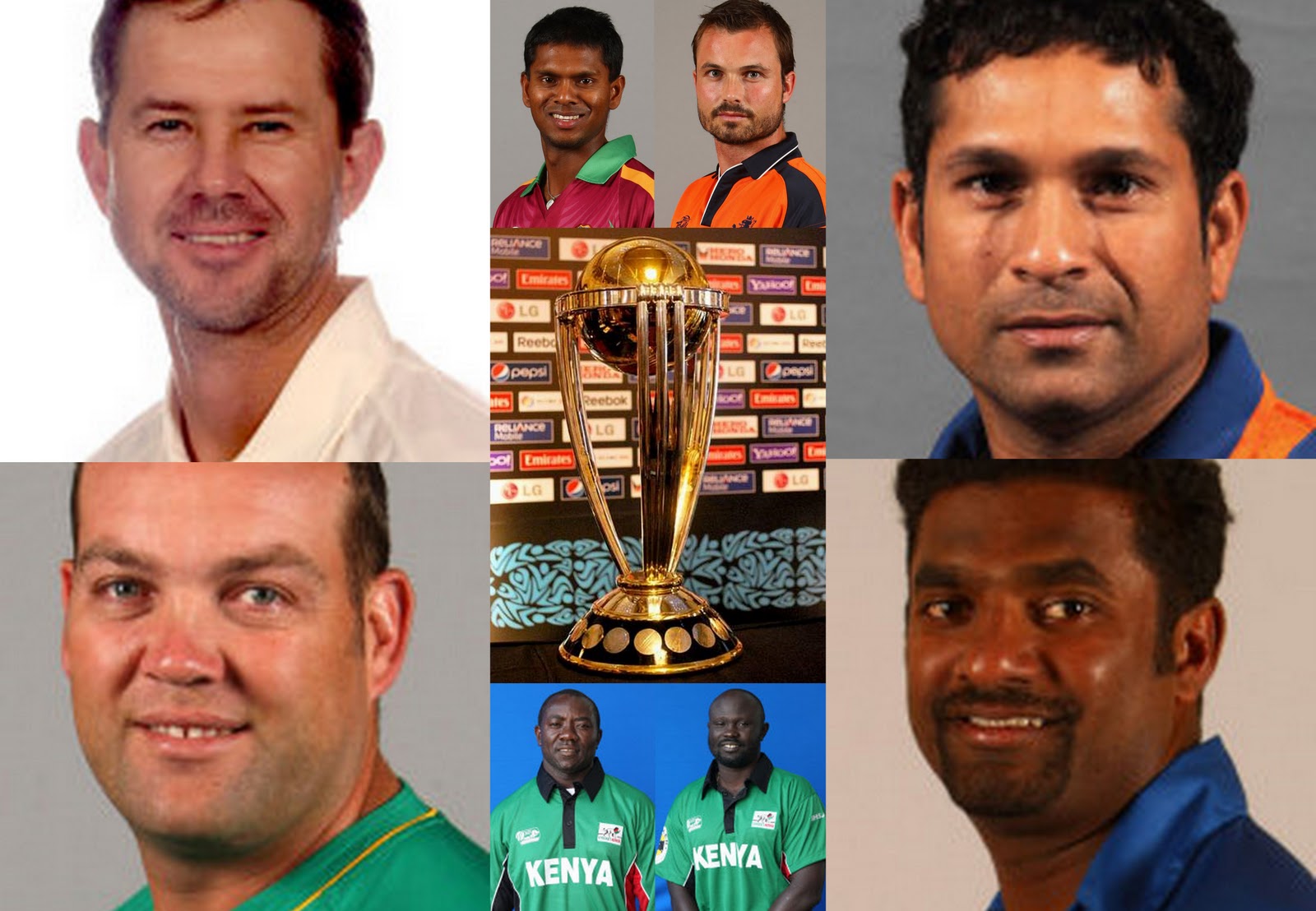
Interestingly, 8 of the 210 players selected for this World Cup were also a part of their teams' set-up 15 years ago in the 1996 World Cup. And amusingly, the team that has the most number of players today from the 1996 era is... Kenya! They have 2, whereas Australia, India, Netherlands, South Africa, Sri Lanka and West Indies have 1 each
.


These men are:

Australia - Ricky Ponting
India - Sachin Tendulkar
Kenya - Thomas Odoyo
Kenya - Steve Tikolo
Netherlands - Bas Zuiderent
South Africa - Jacques Kallis
Sri Lanka - Muttiah Muralitharan
West Indies - Shivnarine Chanderpaul

For Odoyo, Tikolo and Zuiderent, it marked the start of their international careers. For Ponting, Kallis, Muralitharan and Chanderpaul, it marked their World Cup debuts. Tendulkar had already played in the 1992 World Cup.

Interestingly, four of these eight men figured in the semi-finals in 1996. If we were to replace Chanderpaul's West Indies with Kallis' South Africa, we might well have the semi-final line-up for 2011... though I can already hear the English cricket fans vehemently disagreeing.

The youngest of these 8 is the Dutchman Bastiaan Zuiderent, who is a little short of his 34th birthday. And if he remains fit enough and Netherlands competitive enough, he may well go on to play the 11th World Cup in 2015 in Australia and New Zealand! But unless Tendulkar continues to play till then, I will not be able to do such a blog comparing 2015 to 1992!

Enhanced by Zemanta

Friday, July 9, 2010

COLOURFUL CRICKET

Various shades of cricket...

Tuesday, March 30, 2010

DUE TO DEW

Talk of Twenty20 being an unpredictable game... and the IPL is proving it! Harbhajan Singh, in an inspired display of his cricketing abilities over 4 consecutive overs (3 while batting and 1 while bowling), completely turned the game between Deccan Chargers and Mumbai Indians on it head.

The crowd at Dr. D.Y. Patil Sports Academy Stadium seemed almost indignant at the fact that they were hosting an 'away' game for Mumbai Indians... so they made their feelings clear at the top of their voices by showing clearly who they were out to support.

However, when I say that IPL is proving the unpredictability of Twenty20 format, I have a few numbers here to prove it. Out of the 26 games played (till yesterday's DD v KKR), 13 have been won by teams winning the toss. If winning the toss can guarantee you a win on half the occasions only, that is an ideal ratio!

Compare it with the ODIs: In the year 2010, 35 ODIs have given a result (matches between Kenya, Netherlands, Afghanistan and Canada excluded from analysis). Out of the 35 matches, 21 have been won by the side winning the toss. That is 60% of the ODI matches are decided at the toss.

In the subcontinent (especially in day-night matches), this percentage rises even higher. Matches are decided at the time of toss itself due to the 'dew factor'. In Twenty20s, since the conditions to both the teams are relatively same, the 'dew factor' does not have a lot of say.

An IPL Twenty20 match gets over in 3.5 hours (an International T20 takes lesser time). That's the time one innings in an ODI takes. So the conditions faced by both the teams remain similar throughout the match.

One captain who is usually extremely lucky with his coin tosses, though not so much in this IPL, is Kumar Sangakkara. However, his luck is not getting transformed into luck for his team. He will be desperately hoping for some luck as KXIP take on the table-toppers MI this evening.

Tuesday, January 26, 2010

COMMON SENSE CRICKET

Rise from slumber, Pakistan! Reading about Australia's whitewash over Pakistan (and especially, the manner of winning the Second Test), a lot of thoughts raced through my mind. Although surprised, I told myself that I shouldn't be. Over years, Pakistan and Australia have managed similar feats many a time. Pakistan is used to squandering advantageous positions and Australia is used to making a contest out of hopeless situations.

I am neither a Pakistan basher, nor their staunch supporter (which is a rare breed amongst Indians). However, their New Year Test Match against Australia in Sydney caught my attention to the extent that even weeks after it has ended, I feel that I need to write about it.

At the end of Day 1, having bundled out Australia for 127 and then reached 14 without loss at stumps, Pakistan would have (or should have) felt that they have a firm grip on the match. At the end of Day 2, having reached 331/9, Pakistan must have felt that though they hadn't taken full advantage of their bowlers' performance, they were still in a very good position to finish off the game in another day and a half. What unfolded next defies logic. Australia put in a strong batting performance to set a very achievable target of 176 runs for Pakistan in the fourth innings and then put in a strong bowling performance (aided by some reckless batting from Pakistan) to bundle them out for 139.

Pakistan had put in a phenomenal performance on the first  day. All that Pakistan needed to do to win the Test on third and fourth day was play sensible cricket, just like they had done on the second day. However, a friend of mine told me, Pakistan does not have the ability to sustain common sense cricket for lengthy duration, thereby explaining their wretched performance in Test cricket and laudable success in the shorter versions.

Such performances by a team are unhealthy for Test cricket. Though I can never support Pakistan (because I am a patriotic Indian), I certainly want them to do well in Test cricket, along with the likes of West Indies and New Zealand. I wish this for the betterment of Test cricket. I am not scared about the future of Test cricket as I have already expressed in an earlier post on this blog. However, I don't want the future confined to a few Test playing nations.

During the first half of the previous decade, we had ten Test playing nations. Of these, Australia and Bangladesh remained out of reach - one at the top and the other at the bottom. Soon, Zimbabwe went into strife and were suspended from Test cricket. Though Australia soon came within reach of certain other teams, Bangladesh's results haven't improved a great deal (even though their performances did improve significantly). With inconsistent performances from Pakistan, West Indies and New Zealand, test cricket soon became and still is, predominantly, a five - horse race. Sri Lanka have not had enough opportunities to play against top quality oppositions (except for India, whom they will be treating as brothers by now, I guess). England's performances, though exciting, have also been inconsistent - they depend as much on saving matches as other teams depend on winning matches. I shouldn't be complaining though. Their matches have provided some of the best advertisement that Test cricket has had over the past few years.

Amidst all this, it was pleasantly shocking to hear a few weeks back that Ireland harboured hopes of gaining Test status. I was very impressed by the Irish performance in the 2007 World Cup (not because they beat Pakistan - I was more worried about India's chances after the loss to Bangladesh on the same day... sorry, it was night in India). I really wish that their case is handled well and we have a genuinely competent new Test playing nation soon. I don't want their case to be like Bangladesh's (not getting enough results in a decade of  Test status) or like Kenya's (impressing in 2003 World Cup before fading away once again).

I hope, for a prosperous future of Test cricket, that the Test pool becomes a more competent one and that the next generation of Pakistani cricketers are taught the concept on common sense cricket. Its certainly possible (the ICC website, on Pakistan's U-19 win over India,  reported that Pakistan's fielding was exceptional). So you see, anything is possible.

SAVE OUR TIGER!