In less than 20 hours from now, Afghanistan will play against their neighbour Pakistan in an ODI at Sharjah. It will be the first time that Afghanistan will be competing against a Test-playing nation in an ODI. Their first Test-playing opponent in a Twenty20 International had been India during the World Twenty20 Championships 2010. Now they play the longer version of the game against a country with whom they share a longer border.
The Afghan team has been very impressive in its short cricketing journey thus far. Those who have watched the movie 'Out of the Ashes' will know about their rise from the World Cricket League Division 5 through to the ODI status. And it did not stop there. They won the ICC Intercontinental Cup 2009-10, by managing 6 outright wins in 7 First Class games, including the finals against Scotland at Dubai. In the current version of the same (i.e. ICC Intercontinental Cup 2011-13), they are standing currently at the 3rd position after 2 matches, behind Ireland and United Arab Emirates.
No one really expects Afghanistan to beat Pakistan in the one-off ODI to be played tomorrow at Sharjah. But what everyone would dearly like to see is a good fight. They are unlikely to match the Pakistan team in skills, but who wouldn't love to see them show some spark on the field!
Their next major assignment after this ODI shall be the World Twenty20 Championship Qualifiers to be held in mid-March, followed by the World Cricket League Championship (2 ODIs) and the ICC Intercontinental Cup (1 four-day First Class match) assignments against the Netherlands at their adopted home grounds in the UAE.
They have been now, for quite some time, a team that I have fascinatingly followed. I wish them all the luck in these fixtures, and hope that their fairytale stretches on for a long time.
Showing posts with label ODIs. Show all posts
Thursday, February 9, 2012
Friday, February 3, 2012
PUTTING THIS TWENTY20 WIN IN PERSPECTIVE
India's win over Australia at the MCG in the second Twenty20 International was the first away win in an international match for India since 23rd June 2011, which was the 4th day of the First Test on the tour of West Indies. That is a gap of a whopping 225 days!
Since the turn of the millennium, this was just the 4th occasion when India has had to wait for more than 200 days for an away (including neutral matches) win. The earlier three occasions were:
- From 13th November 2000 (Test win over Bangladesh at Dhaka) to 10th June 2001 (Test win over Zimbabwe at Harare) - 209 days.
- From 16th April 2003 (ODI win over Bangladesh at Dhaka) to 16th December 2003 (Test win over Australia at Adelaide) - 244 days.
- From 27th December 2004 (ODI win over Bangladesh at Dhaka) to 30th July 2005 (ODI win over West Indies at Dambulla) - 216 days.
But while these numbers of over 200 days may look very large at first, none of those droughts were half as bad as the recently-ended one! In the 209-day gap of 2000-01, there was no away match played by India. That gap was a result of scheduling, not performances! In the 244-day gap of 2003, India played just 2 neutral ODIs against South Africa at Bangladesh (1 lost and 1 no result) and 1 Test against Australia (draw) at Brisbane. And in the 216-day gap of 2004-05, India played and lost just one ODI against Sri Lanka at Dambulla.
However, in this recently-ended drought of 225 days, India played 10 Tests (losing 8, drawing 2), 2 Twenty20 Internationals (lost both), and 5 ODIs (3 lost, 1 tied and 1 no result). That is a run of 17 win-less away internationals!
The most staggering fact is this - after the first ever away win against New Zealand at Dunedin Test of February 1968, India has never had a win-less streak of away international matches as big as this 17-match one! India played 43 away Test matches from June 1932 to January 1968 without a win, which remains India's longest win-less streak in away international matches, but since then, the largest one was the one that ended a few hours ago!
(P.S.: And since we are talking numbers, this is the 400th post on CRIC - SIS.)
Saturday, August 20, 2011
THE DRAVID SELECTION DEBATE
After what's been a nightmare of a Test series for an Indian cricket fan, the only silver lining is that it can continue for just 3 more days. I hope the change from white to blue will change the fortunes as well!
Talking of white to blue, I was just thinking about the Indian ODI squad for the 5-match series later. And obviously, the biggest surprise in that list was a certain Rahul Dravid.
Dravid has been one of the face-savers of India's batting in this Test series. With 2 hundreds against his name, he does seem to have gotten his touch back after a not-so-good run over the past 2 years. It was nice to see him bat the way he did, and the best aspect of his batting on this tour for me was that he did not get bogged down even when India was in a backs-to-the-wall situation (which was often). He still played his shots when the bad balls came (which was rare)! Over the last 2 years, I think he used to get bogged down quite easily but it didn't affect India much because the men around him were having golden runs.
Coming back to the ODI squad, as good a form as Dravid may be in, it was a surprise still to see him named in the ODI squad. I know that the Test team has been hammered by the English bowlers and English conditions. Yet, I somehow feel that asking Dravid to strengthen the ODI squad's Middle Order is a bit of a regressive step.
The last ODI that India played under MS Dhoni, it defeated Sri Lanka by 6 wickets in a match that was the finals of a World Cup! If you do not retain faith in a World Cup winning squad, it is quite a disappointment.
For the sake of argument, people would say that India was the No. 1 Test team too going into this Test series. Yet is floundered in a big way! But the point is, are we going to use this Test series then as a judgement scale for all our future selections in all formats of the game? Yes, it was a nightmare of a series, as I have already stated. But the ODI squad is different - even if it has to fail, it should be allowed its own chance to fail! The fact that the selectors have decided beforehand that the ODI squad is likely to fail and thus it requires services of Rahul Dravid, even without giving it a chance to fail, has disappointed me immensely.
The selectors have often been criticised for making Test selections on the basis of ODI performances, and Suresh Raina is still used as a case in point. Now they are making an ODI selection on the basis of Test cricket. How is the latter justified if the former is considered wrong?
I remember the time when the Vengsarkar-led selection panel decided to field a very young and inexperienced ODI squad against Australia in Australia. Back then, Australia were the reigning World Champions and also the World No. 1 team in ODIs (as they still are). Yet, we were bold enough to test our younger lot in the harshest way possible.
A certain Gautam Gambhir was the highest run-scorer for India in that tri-series. That same Gautam Gambhir went on to have a brilliant run in Test cricket over the next 2 years, and a little over 3 years after that tri-series, that same Gautam Gambhir fell 3 runs short of a World Cup final winning century while chasing a stiff target!
As a fan of the Fab Four batting lineup, I do feel happy to see Dravid back in the ODI squad. But as an Indian cricket fan, I do not think it is a move in the right direction. Rahul Dravid was persisted with despite a prolonged slump in his batting performances for over 2 years. I think the selectors should have shown similar faith in India's ODI batting unit!
Talking of white to blue, I was just thinking about the Indian ODI squad for the 5-match series later. And obviously, the biggest surprise in that list was a certain Rahul Dravid.
Dravid has been one of the face-savers of India's batting in this Test series. With 2 hundreds against his name, he does seem to have gotten his touch back after a not-so-good run over the past 2 years. It was nice to see him bat the way he did, and the best aspect of his batting on this tour for me was that he did not get bogged down even when India was in a backs-to-the-wall situation (which was often). He still played his shots when the bad balls came (which was rare)! Over the last 2 years, I think he used to get bogged down quite easily but it didn't affect India much because the men around him were having golden runs.
Coming back to the ODI squad, as good a form as Dravid may be in, it was a surprise still to see him named in the ODI squad. I know that the Test team has been hammered by the English bowlers and English conditions. Yet, I somehow feel that asking Dravid to strengthen the ODI squad's Middle Order is a bit of a regressive step.
The last ODI that India played under MS Dhoni, it defeated Sri Lanka by 6 wickets in a match that was the finals of a World Cup! If you do not retain faith in a World Cup winning squad, it is quite a disappointment.
For the sake of argument, people would say that India was the No. 1 Test team too going into this Test series. Yet is floundered in a big way! But the point is, are we going to use this Test series then as a judgement scale for all our future selections in all formats of the game? Yes, it was a nightmare of a series, as I have already stated. But the ODI squad is different - even if it has to fail, it should be allowed its own chance to fail! The fact that the selectors have decided beforehand that the ODI squad is likely to fail and thus it requires services of Rahul Dravid, even without giving it a chance to fail, has disappointed me immensely.
The selectors have often been criticised for making Test selections on the basis of ODI performances, and Suresh Raina is still used as a case in point. Now they are making an ODI selection on the basis of Test cricket. How is the latter justified if the former is considered wrong?
I remember the time when the Vengsarkar-led selection panel decided to field a very young and inexperienced ODI squad against Australia in Australia. Back then, Australia were the reigning World Champions and also the World No. 1 team in ODIs (as they still are). Yet, we were bold enough to test our younger lot in the harshest way possible.
A certain Gautam Gambhir was the highest run-scorer for India in that tri-series. That same Gautam Gambhir went on to have a brilliant run in Test cricket over the next 2 years, and a little over 3 years after that tri-series, that same Gautam Gambhir fell 3 runs short of a World Cup final winning century while chasing a stiff target!
As a fan of the Fab Four batting lineup, I do feel happy to see Dravid back in the ODI squad. But as an Indian cricket fan, I do not think it is a move in the right direction. Rahul Dravid was persisted with despite a prolonged slump in his batting performances for over 2 years. I think the selectors should have shown similar faith in India's ODI batting unit!
Sunday, July 17, 2011
INDIA'S GREATEST ODI TRIUMPH OUTSIDE OF THE WORLD CUPS
This is an interesting thought that came to my mind when I was reading the Times of India article about the Raina / Yuvraj / No. 6 slot debate. There was this line in that article which said - "Lord's was the venue of India's greatest triumph outside World Cup when it chased down a target of 326 set by England in the 2002 Natwest Trophy and in which Yuvraj had played a critical knock of 69 runs."
While Lord's 2002 was undoubtedly a great win - one of the most memorable ever - but was it India's best ODI triumph outside of the World Cup? Immediately, two other triumphs come to my mind - the 1985 Benson and Hedges World Championship Finals against Pakistan at MCG, and the more recent 2008 Commonwealth Bank Series win over Australia.
If ever a vote is taken on this debate, I am sure that these 3 wins will pile up the maximum hits. Each one has something special about it...
While Lord's 2002 was undoubtedly a great win - one of the most memorable ever - but was it India's best ODI triumph outside of the World Cup? Immediately, two other triumphs come to my mind - the 1985 Benson and Hedges World Championship Finals against Pakistan at MCG, and the more recent 2008 Commonwealth Bank Series win over Australia.
If ever a vote is taken on this debate, I am sure that these 3 wins will pile up the maximum hits. Each one has something special about it...
![]() |
| Which was the greatest of them all? |
2002 - A shirtless Sourav Ganguly on the Lord's balcony in a show of brilliant passion is the lasting image from this triumph. Two youngsters on the scene - Mohammed Kaif and Yuvraj Singh - scripted an unbelievable win when all hope seemed lost. Kaif came in to join Yuvraj at the fall of the big wicket of Sachin Tendulkar and India at 146-5. In a previous era, the fall of Sachin would have been game over for India... but these two young men changed that era right there. That match had passion all right - English captain Nasser Hussain's gestures to the media box on reaching his hundred, Sourav Ganguly's aggression at the start of the Indian innings, his disappointment when he got out, and then the final shirt-waving before pinning Kaif to the ground with his hug! That win changed Indian cricket to an extent that is still being defined, and laid the first slab in the creation of the legend of Sourav Ganguly!
2008 - A young captain, a young team, coming to an end of a bitter tour of Australia, history against them, and what do they do? The Indian team beats Australia in the first 2 finals at SCG and Gabba to win their first ever triangular tournament in Australia. During commentary in the 1st final, when India was closing on to a comfortable win thanks to a Sachin Tendulkar century, Ian Chappell suggested that while Brisbane might favour Australia, the Indians might fancy their chances in Adelaide - the venue of the 3rd final, if needed! How unlike Ian Chappell (or any Australian, for that matter) to even think of losing a match! India certainly did not think that way, and with Sachin Tendulkar scoring over 200 runs in the 2 finals, and some good bowling by a young Praveen Kumar, India sealed a memorable win. The passionate celebration, not only after the win but even on the fall of key wickets of Hayden (the obnoxious weed episode) and Symonds (the monkey-gate saga), in the 2nd final, tell you just how important that win was. It gave a young team of MS Dhoni the confidence to walk ahead and carve its own identity... a win that might well have eventually led to the World Cup triumph of 2011!
I'm not sure which one would I vote as the greatest ODI triumph for India outside of the World Cups of 1983 and 2011. There are other triumphs like the 1998 Sharjah win, 5 Asia Cup wins and 1993 Hero Cup, but these do not have the same feel to them as the wins of 1985, 2002 and 2008. What do you think?
Monday, March 21, 2011
STEVE TIKOLO
What is common between Marcus Trescothick, Subramanium Badrinath, Brad Hodge and Steve Tikolo? These are men who played less Test cricket in consideration of the respective talents that they had. One quit early, one suffered due to lack of chances, one just could not reproduce his domestic level of performances at the highest level, and one... that last one played for an Associate team!
Here's a look at the numbers generated by Steve Tikolo -
An ODI batting average of 29 does not do justice to him. A First Class batting average of almost 50 is a better indicator. The fact that he is the highest run-scorer in ODI cricket amongst players from Associate teams tells one story, the fact that the person second to him is a good 1003 runs behind him (just about 70% of his total) tells another story!
He's amongst the very few cricketers in the world who have played in 5 World Cups - a feat unachieved by 4 of the top-10 run-scorers in the history of ODI cricket and 7 of the top-10 wicket-takers. At one point in time, he was widely regarded as the best batsman outside of the Test-playing nations. Not without reason!
He was the captain when Kenya achieved their cricketing peak in 2003, when they reached the semi-finals of the World Cup 2003. He was present even in this World Cup in 2011, when Kenyan cricket is at its "lowest ebb".
He's been there and done that in respect of Kenyan cricket. He made his ODI debut together with Kenya's debut in a World Cup - back in 1996. He was a part of Kenya's first biggest triumph - the win over West Indies at Pune in that World Cup. He helped Kenya qualify for the next World Cup in 1999, and was their best player there. He led Kenya to a World Cup semi-finals in 2003. When the Kenyan cricket administration fell out with its stakeholders, he led a players' revolt to oust that old regime and took up the effort of rebuilding Kenyan cricket. It was fitting that the name synonymous with Kenyan cricket led them in his final appearance for them at an iconic ground, the Eden Gardens!
The farewell for Steve Tikolo did not go according to the script. But it was heartening to see his opponents (the Zimbabweans) giving him their respectful compliments when he made his final walk back to the pavilion as a Kenyan cricketer! Some players see their greatness celebrated, some others see their greatness hide in pages of history. Steve Tikolo was one of the latter breed of great cricketers, and this is just one of those pages of history!
To end this tribute to Steve Tikolo on a light note, here's what Andy Zaltzman tweeted in reply to me in respect of this Kenyan legend:
All the best for your future ventures, Steve Tikolo!
Here's a look at the numbers generated by Steve Tikolo -
An ODI batting average of 29 does not do justice to him. A First Class batting average of almost 50 is a better indicator. The fact that he is the highest run-scorer in ODI cricket amongst players from Associate teams tells one story, the fact that the person second to him is a good 1003 runs behind him (just about 70% of his total) tells another story!
He's amongst the very few cricketers in the world who have played in 5 World Cups - a feat unachieved by 4 of the top-10 run-scorers in the history of ODI cricket and 7 of the top-10 wicket-takers. At one point in time, he was widely regarded as the best batsman outside of the Test-playing nations. Not without reason!
He was the captain when Kenya achieved their cricketing peak in 2003, when they reached the semi-finals of the World Cup 2003. He was present even in this World Cup in 2011, when Kenyan cricket is at its "lowest ebb".
He's been there and done that in respect of Kenyan cricket. He made his ODI debut together with Kenya's debut in a World Cup - back in 1996. He was a part of Kenya's first biggest triumph - the win over West Indies at Pune in that World Cup. He helped Kenya qualify for the next World Cup in 1999, and was their best player there. He led Kenya to a World Cup semi-finals in 2003. When the Kenyan cricket administration fell out with its stakeholders, he led a players' revolt to oust that old regime and took up the effort of rebuilding Kenyan cricket. It was fitting that the name synonymous with Kenyan cricket led them in his final appearance for them at an iconic ground, the Eden Gardens!
The farewell for Steve Tikolo did not go according to the script. But it was heartening to see his opponents (the Zimbabweans) giving him their respectful compliments when he made his final walk back to the pavilion as a Kenyan cricketer! Some players see their greatness celebrated, some others see their greatness hide in pages of history. Steve Tikolo was one of the latter breed of great cricketers, and this is just one of those pages of history!
To end this tribute to Steve Tikolo on a light note, here's what Andy Zaltzman tweeted in reply to me in respect of this Kenyan legend:
All the best for your future ventures, Steve Tikolo!
Sunday, January 30, 2011
A NEW IDEA FOR WORLD CUP FORMAT
The World Cup is back to a 14-team format from the 16-team format tried out in the previous edition. The format for 2011 is similar to the one used for 1996 edition, except that only 12 teams played back then. The concept of Quarter Finals will be used only for the 2nd time in cricket World Cups after 1996.
I am one of those people who like to see minnows in action. I know that ICC is of the opinion that minnows shall be given exposure against the top teams in the Twenty20 format... but I like to see them play top teams in ODIs too. The reason why I feel that they should get more ODI games against top teams is that ODIs are closer to Test cricket than Twenty20s.
In future, I would love to see an expanded Test pool. I would love to see the smaller teams like Ireland, Netherlands and Kenya be a part of Test cricket. I was absolutely delighted when the news had surfaced some time back that the Irish cricket has ambitions of breaking into Test cricket arena. I would love to see it happen sooner rather than later. And that's why I believe that ODI experiences will help them more in this regard than Twenty20s.
That is why I was happy to see 16 teams competing in 2007, even though I did not really approve of the format. Even this time round, even before the first ball is bowled, there are complains about the format and how it will be a drag towards the latter half of the first round.
There were 51 matches in 2007 and there will be 49 matches in 2011. The format that I have in mind have more matches than these - a total of 57 matches with 16 teams. But it will have lesser number of meaningless matches than these two formats.
Here's my format:
16 teams in four groups - A, B, C, D.
Stage 1 is a Double Round Robin, where each team plays the rest in its group twice (like it happened in 1983 and 1987). This stage will thus stage 48 matches (16 teams playing 6 matches each).
The teams that finish top-2 in each group shall advance ahead. The team that finishes 3rd will not advance, but will have automatically qualified to be a part of the next World Cup. The team that finishes 4th will have to play a qualifying round to be eligible to feature in the next World Cup.
Stage 2 is slightly different (inspired by the IPL format this year). Here are the matches in this stage:
Match 1: Pre Quarter Final 1 - A2 v. B2
Match 2: Pre Quarter Final 2 - C2 v. D2
Match 3: Quarter Final 1 - A1 v. B1
Match 4: Quarter Final 2 - C1 v. D1
Match 5: Quarter Final 3 - Winner of PQF 1 v. Loser of QF 1
Match 6: Quarter Final 4 - Winner of PQF 2 v. Loser of QF 2
This will be followed by Semi - finals and the Finals.
Well, this is my format consisting of 57 matches (48 + 6 + 2 + 1). Here are what I see as advantages in this format:
1. It obviously allows a chance to the smaller teams to compete against the bigger teams, and twice at least against each big team in their group. This will give them a chance to improve on their mistakes that they made in the first match, and see if they make any progress in the second "revenge" match, as it used to be called in 1983 and 1987.
2. Unlike 2007 where 16 teams featured, there is a lesser chance of big teams exiting in the first round itself since they will have 6 matches in comparison to 3 that they had back then. So even if they do suffer an upset, they should still comfortably get in to the next round.
3. There will be motivation to fight for the top spot in the group as it would mean the team is one step closer to the semis. And even if the team falters in that step, it will still get another chance to be in the semis because it finished first in the group.
4. For a change, minnows will not be playing just to make up the numbers or "for pride". They will have an added motivation to finish 3rd in the group to secure a spot in the next World Cup. Minnows usually don't get to play matches in such big events where something is at stake. This will be their big chance to play matches for a spot in a premier tournament. If they know that they have qualified to feature in the next World Cup, they can start preparing and planning a squad four years in advance.
The biggest drawback of this format, as I see it, is that it is way too lengthy. 57 matches might be a bit of a drag to many fans. And there aren't a lot of people who would like to see minnows in action in so many matches. After all, high profile matches attract the crowds, not Ireland v. Netherlands games!
However, I had to put forth this idea the moment it struck my head. Usually, such ideas strike me in my sleep and this one was no different! I would love to have your feedback on what you may deem to be other pros and cons of this format or any suggestion or improvement to this format or a completely different format altogether.
I am one of those people who like to see minnows in action. I know that ICC is of the opinion that minnows shall be given exposure against the top teams in the Twenty20 format... but I like to see them play top teams in ODIs too. The reason why I feel that they should get more ODI games against top teams is that ODIs are closer to Test cricket than Twenty20s.
In future, I would love to see an expanded Test pool. I would love to see the smaller teams like Ireland, Netherlands and Kenya be a part of Test cricket. I was absolutely delighted when the news had surfaced some time back that the Irish cricket has ambitions of breaking into Test cricket arena. I would love to see it happen sooner rather than later. And that's why I believe that ODI experiences will help them more in this regard than Twenty20s.
That is why I was happy to see 16 teams competing in 2007, even though I did not really approve of the format. Even this time round, even before the first ball is bowled, there are complains about the format and how it will be a drag towards the latter half of the first round.
There were 51 matches in 2007 and there will be 49 matches in 2011. The format that I have in mind have more matches than these - a total of 57 matches with 16 teams. But it will have lesser number of meaningless matches than these two formats.
Here's my format:
16 teams in four groups - A, B, C, D.
Stage 1 is a Double Round Robin, where each team plays the rest in its group twice (like it happened in 1983 and 1987). This stage will thus stage 48 matches (16 teams playing 6 matches each).
The teams that finish top-2 in each group shall advance ahead. The team that finishes 3rd will not advance, but will have automatically qualified to be a part of the next World Cup. The team that finishes 4th will have to play a qualifying round to be eligible to feature in the next World Cup.
Stage 2 is slightly different (inspired by the IPL format this year). Here are the matches in this stage:
Match 1: Pre Quarter Final 1 - A2 v. B2
Match 2: Pre Quarter Final 2 - C2 v. D2
Match 3: Quarter Final 1 - A1 v. B1
Match 4: Quarter Final 2 - C1 v. D1
Match 5: Quarter Final 3 - Winner of PQF 1 v. Loser of QF 1
Match 6: Quarter Final 4 - Winner of PQF 2 v. Loser of QF 2
This will be followed by Semi - finals and the Finals.
Well, this is my format consisting of 57 matches (48 + 6 + 2 + 1). Here are what I see as advantages in this format:
1. It obviously allows a chance to the smaller teams to compete against the bigger teams, and twice at least against each big team in their group. This will give them a chance to improve on their mistakes that they made in the first match, and see if they make any progress in the second "revenge" match, as it used to be called in 1983 and 1987.
2. Unlike 2007 where 16 teams featured, there is a lesser chance of big teams exiting in the first round itself since they will have 6 matches in comparison to 3 that they had back then. So even if they do suffer an upset, they should still comfortably get in to the next round.
3. There will be motivation to fight for the top spot in the group as it would mean the team is one step closer to the semis. And even if the team falters in that step, it will still get another chance to be in the semis because it finished first in the group.
4. For a change, minnows will not be playing just to make up the numbers or "for pride". They will have an added motivation to finish 3rd in the group to secure a spot in the next World Cup. Minnows usually don't get to play matches in such big events where something is at stake. This will be their big chance to play matches for a spot in a premier tournament. If they know that they have qualified to feature in the next World Cup, they can start preparing and planning a squad four years in advance.
The biggest drawback of this format, as I see it, is that it is way too lengthy. 57 matches might be a bit of a drag to many fans. And there aren't a lot of people who would like to see minnows in action in so many matches. After all, high profile matches attract the crowds, not Ireland v. Netherlands games!
However, I had to put forth this idea the moment it struck my head. Usually, such ideas strike me in my sleep and this one was no different! I would love to have your feedback on what you may deem to be other pros and cons of this format or any suggestion or improvement to this format or a completely different format altogether.
Thursday, December 30, 2010
ODI TEAM OF THE YEAR 2010
Here's my pick for the ODI team for the year 2010...
01. Hasim Amla (1058 runs in 15 matches @ Avg 75.57 and SR 104.23, 100s-5, 50s-4) - SA
02. Tillakaratne Dilshan (921 runs in 20 matches @ Avg 51.16 and SR 988.82, 100s-3, 50s-4) - SL
03. Virat Kohli (995 runs in 25 matches @ Avg 47.38 and SR 85.11, 100s-3, 50s-7) - Ind
04. AB De Villiers (964 runs in 16 matches @ Avg 80.33 and SR 102.11, 100s-5, 50s-4) - SA
05. Kumar Sangakkara (726 runs in 17 matches @ Avg 48.40 and SR 84.41, 100s-0, 50s-7, Cat-27, St-4) (c)(wk) - SL
06. Michael Hussey (825 runs in 24 matches @ Avg 45.83 and SR 91.56, 100s-0, 50s-6) - Aus
07. Shakib Al Hasan (27 matches, 787 runs @ Avg 32.79, SR 80.14, 100s-1, 50s-5, 46 wkts @ Avg 26.00, ER 4.80) - Ban
08. Graeme Swann (28 wkts in 14 matches @ Avg 18.67 and ER 4.25) - Eng
09. Stuart Broad (30 wkts in 16 matches @ Avg 24.86 and ER 5.21) - Eng
10. Ryan Harris (40 wkts in 16 matches @ Avg 15.17 and ER 4.63) - Aus
11. Doug Bollinger (28 wkts in 19 matches @ Avg 23.39 and ER 4.36) - Aus
01. Hasim Amla (1058 runs in 15 matches @ Avg 75.57 and SR 104.23, 100s-5, 50s-4) - SA
02. Tillakaratne Dilshan (921 runs in 20 matches @ Avg 51.16 and SR 988.82, 100s-3, 50s-4) - SL
03. Virat Kohli (995 runs in 25 matches @ Avg 47.38 and SR 85.11, 100s-3, 50s-7) - Ind
04. AB De Villiers (964 runs in 16 matches @ Avg 80.33 and SR 102.11, 100s-5, 50s-4) - SA
05. Kumar Sangakkara (726 runs in 17 matches @ Avg 48.40 and SR 84.41, 100s-0, 50s-7, Cat-27, St-4) (c)(wk) - SL
06. Michael Hussey (825 runs in 24 matches @ Avg 45.83 and SR 91.56, 100s-0, 50s-6) - Aus
07. Shakib Al Hasan (27 matches, 787 runs @ Avg 32.79, SR 80.14, 100s-1, 50s-5, 46 wkts @ Avg 26.00, ER 4.80) - Ban
08. Graeme Swann (28 wkts in 14 matches @ Avg 18.67 and ER 4.25) - Eng
09. Stuart Broad (30 wkts in 16 matches @ Avg 24.86 and ER 5.21) - Eng
10. Ryan Harris (40 wkts in 16 matches @ Avg 15.17 and ER 4.63) - Aus
11. Doug Bollinger (28 wkts in 19 matches @ Avg 23.39 and ER 4.36) - Aus
Thursday, December 2, 2010
GLAD FOR GAUTAM GAMBHIR
It was good to see Gautam Gambhir back in the runs with a big century... the icing on the cake was that he did this as a captain!
After a record-breaking season and a half for Gambhir, he has struggled this year for his runs. He has also not been helped by regular occurrence of injuries and some shoddy umpiring (remember Billy Bowden's howler!?). But in the Tests against New Zealand, he showed that he is slowly getting his form back... and now in the 2nd ODI, he hit a wonderful 138* to send out a string message to those who were thinking of handing his spot over to Murali Vijay.
I am delighted for Gambhir. I have mentioned earlier that it took me time to warm up to Gautam Gambhir, but over his purple patch (particularly that marathon match-saving century at Napier) I saw that he's a changed man from the one I had seen make his debut in 2004. He had improved beyond recognition.
When he was going through that purple patch, I knew that a bad patch would come. Runs will dry up. It happens to everyone, just as it may soon happen to Sachin Tendulkar and Virender Sehwag (though I always hope not!). But having had a changed opinion of Gambhir now, I was confidently hoping that he'll find his way out of th mire.
His 138* today was not the perfect innings. There were a couple of streaky inside edges that went either side of the stumps... and there was a bit of impatience at the start. But once all those start-of-an-innings-jitters were out of the way, his innings was as good as they get in One Day International cricket. No doubt his counterpart Daniel Vettori describe it as "one of the best one-day innings I have ever seen"!
There was the 5th ball of the 33rd over bowled by Kyle Mills, when Gambhir shimmied down the track looking to create room but got cramped up as Mills followed him. Yet he had so much time even after coming a couple of paces down to a pacer that he comfortably guided the ball to the right of point, wide of the third man, to pick up an easy 2 and move from 91 to 93. It almost looked as if Gambhir paused and decided that this was the place he wanted to play the ball to, and then played it. It looked so comfortable that I immediately felt that yes, this man has returned to form.
It was a great knock by the Indian captain and as I end this blog, I must also mention a special word for the young Virat Kohli. He's been quite a bit like Gambhir for me... took a bit of time to warm up to him... but he's impressed with his maturity at the crease. Though there is still a lot that he needs to prove, there is no doubt that he's taking all the right steps.
After a record-breaking season and a half for Gambhir, he has struggled this year for his runs. He has also not been helped by regular occurrence of injuries and some shoddy umpiring (remember Billy Bowden's howler!?). But in the Tests against New Zealand, he showed that he is slowly getting his form back... and now in the 2nd ODI, he hit a wonderful 138* to send out a string message to those who were thinking of handing his spot over to Murali Vijay.
I am delighted for Gambhir. I have mentioned earlier that it took me time to warm up to Gautam Gambhir, but over his purple patch (particularly that marathon match-saving century at Napier) I saw that he's a changed man from the one I had seen make his debut in 2004. He had improved beyond recognition.
When he was going through that purple patch, I knew that a bad patch would come. Runs will dry up. It happens to everyone, just as it may soon happen to Sachin Tendulkar and Virender Sehwag (though I always hope not!). But having had a changed opinion of Gambhir now, I was confidently hoping that he'll find his way out of th mire.
His 138* today was not the perfect innings. There were a couple of streaky inside edges that went either side of the stumps... and there was a bit of impatience at the start. But once all those start-of-an-innings-jitters were out of the way, his innings was as good as they get in One Day International cricket. No doubt his counterpart Daniel Vettori describe it as "one of the best one-day innings I have ever seen"!
There was the 5th ball of the 33rd over bowled by Kyle Mills, when Gambhir shimmied down the track looking to create room but got cramped up as Mills followed him. Yet he had so much time even after coming a couple of paces down to a pacer that he comfortably guided the ball to the right of point, wide of the third man, to pick up an easy 2 and move from 91 to 93. It almost looked as if Gambhir paused and decided that this was the place he wanted to play the ball to, and then played it. It looked so comfortable that I immediately felt that yes, this man has returned to form.
It was a great knock by the Indian captain and as I end this blog, I must also mention a special word for the young Virat Kohli. He's been quite a bit like Gambhir for me... took a bit of time to warm up to him... but he's impressed with his maturity at the crease. Though there is still a lot that he needs to prove, there is no doubt that he's taking all the right steps.
Sunday, August 22, 2010
INDIA'S TEST BATTING - THE FOUNDATION OF NO. 1 SPOT
Whenever MS Dhoni's One Day team puts in disastrous performances like the one that was witnessed today, I like to think about out Test team... just to lighten up my dark mood!
So today, I decided to do a bit of number-searching. Here's what I found - India's performance in last 25 Test matches: Win - 12, Loss - 5, Draw - 8.
I have blogged a lot about how India's bowling unit (even in Tests) is very poor, but India is till managing to hold on to the No. 1 spot on the strength of its mighty batting. I decided to search for numbers that prove my viewpoint.
In these 25 Tests, India's bowling has managed to pick up 20 opposition wickets only on 11 occasions. So it's surprising to see 12 wins in the above stats, isn't it? That 1 win without grabbing 20 wickets (we did take 19 though) came against England in Chennai, where after England's declaration on their 9th second innings wicket, Sehwag led a brutal assault on the Kevin Pietersen - led team to mastermind an unprecedented chase on the Indian soil.
Coming back to the point, have you noticed that every time that the Indian bowling unit picks up 20 wickets in a Test, our batting manages to have enough runs on the board to win the Test... 'Time' is an immaterial factor in India's batting unit - there are men who save it, there are men who waste it, and there are men who can do both of it!
This stat is a remarkable one. Though I have not checked for the other teams, I am sure not many teams will be able to boast of having won every Test in which they have picked up 20 opposition wickets. This is a testimony to the remarkable abilities of India's batting stalwarts!
On the other hand, India has lost 20 wickets in only 6 occasions in these 25 Tests. And on one of these 6 occasions, the batsmen had scored more than enough to seal a win... so India's batting has truly failed only on 5 occasions in Test cricket over 2 and a half years! It may still not be the hallmark of a Test Champion side, but which other side has managed to perform as such over the last few years!?
Sehwag, the only one to have featured in each one of these 25 matches, scores at the rate of more than 100 runs per Test match... amassing 2598 runs during this period. Four batsmen have managed more than 15 scores of 50 or above... (Laxman - 17 from 23 Tests, Sehwag - 17 from 25 Tests, Sachin 16 from 23 Tests and Gambhir 16 from 18 Tests).
Though Raina has made a promising debut (albeit on the flattest track I have seen for quite some time), I am quite uncertain about life after Sachin, Rahul and VVS. They will have a lot of learning to do... and it is not going to be easy!
P.S.: Amidst all these numbers, you might have failed to notice that only 1 Test of India's last 25 have resulted in 20 wickets falling... and guess where it came!?
.
.
.
.
In a stadium, which in its small history, has been known to be one of the flattest of tracks... it is the VCA Stadium (Jamtha), Nagpur against Australia!
So today, I decided to do a bit of number-searching. Here's what I found - India's performance in last 25 Test matches: Win - 12, Loss - 5, Draw - 8.
I have blogged a lot about how India's bowling unit (even in Tests) is very poor, but India is till managing to hold on to the No. 1 spot on the strength of its mighty batting. I decided to search for numbers that prove my viewpoint.
In these 25 Tests, India's bowling has managed to pick up 20 opposition wickets only on 11 occasions. So it's surprising to see 12 wins in the above stats, isn't it? That 1 win without grabbing 20 wickets (we did take 19 though) came against England in Chennai, where after England's declaration on their 9th second innings wicket, Sehwag led a brutal assault on the Kevin Pietersen - led team to mastermind an unprecedented chase on the Indian soil.
Coming back to the point, have you noticed that every time that the Indian bowling unit picks up 20 wickets in a Test, our batting manages to have enough runs on the board to win the Test... 'Time' is an immaterial factor in India's batting unit - there are men who save it, there are men who waste it, and there are men who can do both of it!
This stat is a remarkable one. Though I have not checked for the other teams, I am sure not many teams will be able to boast of having won every Test in which they have picked up 20 opposition wickets. This is a testimony to the remarkable abilities of India's batting stalwarts!
On the other hand, India has lost 20 wickets in only 6 occasions in these 25 Tests. And on one of these 6 occasions, the batsmen had scored more than enough to seal a win... so India's batting has truly failed only on 5 occasions in Test cricket over 2 and a half years! It may still not be the hallmark of a Test Champion side, but which other side has managed to perform as such over the last few years!?
Sehwag, the only one to have featured in each one of these 25 matches, scores at the rate of more than 100 runs per Test match... amassing 2598 runs during this period. Four batsmen have managed more than 15 scores of 50 or above... (Laxman - 17 from 23 Tests, Sehwag - 17 from 25 Tests, Sachin 16 from 23 Tests and Gambhir 16 from 18 Tests).
Though Raina has made a promising debut (albeit on the flattest track I have seen for quite some time), I am quite uncertain about life after Sachin, Rahul and VVS. They will have a lot of learning to do... and it is not going to be easy!
![]() |
| Masters at what they do... |
P.S.: Amidst all these numbers, you might have failed to notice that only 1 Test of India's last 25 have resulted in 20 wickets falling... and guess where it came!?
.
.
.
.
In a stadium, which in its small history, has been known to be one of the flattest of tracks... it is the VCA Stadium (Jamtha), Nagpur against Australia!
UMPIRING CANNOT BE THE EXCUSE
India's One Day team has put up another horrible performance in Dambulla. There are cries that I hear about poor umpiring. Granted, the umpiring was poor... but the only ones who lost out due to that kind of umpiring were Sehwag and Yuvraj.
Sehwag is in top form and will feel genuinely disappointed at being given out on a ball where most Elite Panel umpires would kept have fingers to themselves. Yuvraj, on the other hand, was getting some very valuable practice in match conditions in a lost cause... but considering that he has been in a very bad form and really needed that practice, he will feel wronged on being cut short by an Asad-Rauf-howler.
Well, as for Dinesh Karthik... the decision may have been wrong, but the umpire just reduced the suffering for Dinesh Karthik and the Indian fans. That guy has now had more than enough opportunities. How he manages to maintain his place as the first replacement to a top-order batsmen with just 20s and rare 30s is beyond my understanding (actually not, it's obviously the Cheeka factor)! And Suresh Raina just had to shrug off his piece of bad luck after having encountered good luck just a few moments before.
And there is no excuse for Rohit Sharma and MS Dhoni. Rohit Sharma frustrates an Indian fan like very few others can... he is so obviously full of unconverted talent! I now fully appreciate the angst of a Bangladesh cricketer over the case of Mohammed Ashraful. In fact, I have a feeling that even I can get Sharma's wicket on my bowling. The only thing I do well is bowl those gentle dibbly-dobbly off-cutters... but then, that is how Rohit Sharma gets out! I can keep bowling those in the knowledge that very soon Sharma will get his front leg across and I will catch him plumb in front!
And MS Dhoni... the skipper! I have always been of the opinion that he is a master of mediocre attacks and mediocre conditions. Once in a while he may come up with a truly astounding performance in a pressure situation... but those occasions are very rare now... and have happened more often for Chennai Super Kings than Team India in 2010. If Dhoni really wanted to play a captain's knock today, he'd play himself higher and not wait till 4 wickets are down to finally show his presence.
But I am still not worried about India's batting scene... because with the entry of Sachin Tendulkar and Gautam Gambhir, not only will a lot of stability be instilled in the team... but also the frustrating figures of Rohit Sharma and Dinesh Karthik will vanish! And considering that the World Cup is in the sub-continent, Dhoni will not be very troubled either...
Sehwag is in top form and will feel genuinely disappointed at being given out on a ball where most Elite Panel umpires would kept have fingers to themselves. Yuvraj, on the other hand, was getting some very valuable practice in match conditions in a lost cause... but considering that he has been in a very bad form and really needed that practice, he will feel wronged on being cut short by an Asad-Rauf-howler.
Well, as for Dinesh Karthik... the decision may have been wrong, but the umpire just reduced the suffering for Dinesh Karthik and the Indian fans. That guy has now had more than enough opportunities. How he manages to maintain his place as the first replacement to a top-order batsmen with just 20s and rare 30s is beyond my understanding (actually not, it's obviously the Cheeka factor)! And Suresh Raina just had to shrug off his piece of bad luck after having encountered good luck just a few moments before.
And there is no excuse for Rohit Sharma and MS Dhoni. Rohit Sharma frustrates an Indian fan like very few others can... he is so obviously full of unconverted talent! I now fully appreciate the angst of a Bangladesh cricketer over the case of Mohammed Ashraful. In fact, I have a feeling that even I can get Sharma's wicket on my bowling. The only thing I do well is bowl those gentle dibbly-dobbly off-cutters... but then, that is how Rohit Sharma gets out! I can keep bowling those in the knowledge that very soon Sharma will get his front leg across and I will catch him plumb in front!
And MS Dhoni... the skipper! I have always been of the opinion that he is a master of mediocre attacks and mediocre conditions. Once in a while he may come up with a truly astounding performance in a pressure situation... but those occasions are very rare now... and have happened more often for Chennai Super Kings than Team India in 2010. If Dhoni really wanted to play a captain's knock today, he'd play himself higher and not wait till 4 wickets are down to finally show his presence.
But I am still not worried about India's batting scene... because with the entry of Sachin Tendulkar and Gautam Gambhir, not only will a lot of stability be instilled in the team... but also the frustrating figures of Rohit Sharma and Dinesh Karthik will vanish! And considering that the World Cup is in the sub-continent, Dhoni will not be very troubled either...
Friday, August 13, 2010
MISSION 2011
India has used 27 players in One Day Internationals in the year 2010. And with the World Cup less than 200 days away now, the ODI unit is looking in deep trouble. Just a few spots are cemented... so one can safely say that a lot of construction work will need to be undertaken.
Lets look at the men who have their places reserved in the team sheet (assuming no injury concerns in February 2011):
Openers: Virendra Sehwag, Sachin Tendulkar, Gautam Gambhir (I know GG is not in the best of nicks right now... but he is a virtual certainty for me as he can rotate the strike very well and knows how to build an innings)
Middle Order: Suresh Raina, MS Dhoni (That's it! From the best middle order in the world in Tests to no middle order at all in limited overs format)
Bowlers: Ashish Nehra, Zaheer Khan, Harbhajan Singh (I put in a lot of thought before typing down Bhajji's name... and yes, both the pacers here are very injury prone)
That leaves three in the first XI and seven more in the XV. I guess Praveen Kumar should be the first of the three vacancies to be filled up - his numbers in ODIs in 2010 read 12 wickets in 7 matches at an average of 22.50, economy of 4.82 and strike rate of 28.00. He is India's third highest wicket taker in ODIs in 2010.
The next vacancy that needs to be filled is in the middle order... where once upon a time, Yuvraj Singh was a certainty! However, his numbers in 2010 make an abysmal reading for a man of his talents. He has 101 runs from 6 ODI outings at an average of 20.20 and a strike rate of just 68.24. He faces stiff competition from Virat Kohli and Rohit Sharma. One might want to add Dinesh Karthik's name here... but I am not one of his fans.
Now, like Harsha Bhogle has suggested in his latest article, if Ravindra Jadeja or Yusuf Pathan do not perform well in the ODIs that India has in the lead up to the World Cup and we do not find suitable replacements... then we might well have to use two of the three names above (Yuvraj Singh, Virat Kohli and Rohit Sharma) in the middle order.
India will have to use its part-time spinners to fill up the fifth bowler's quota of ten overs... something not very unfamiliar for the team. Who are these part-timers? There is Sehwag and Raina amongst the certainties. With Tendulkar not bowling any more and Gambhir playing as a specialist batsman, the selection of the last two middle order spots might well be on the basis of the bowling abilities... and not batting.
If this is the case, then Yuvraj Singh gets a direct entry (not that he shouldn't... but he still needs to answer a lot of questions about his batting form and commitment to the team)! The other spot might go to Rohit Sharma... not that his bowling is great, but he has bowled more often than Virat Kohli (who is far away from Chris Harris' wicket taking record for New Zealand despite having a duplicate bowling action)!
The four reserves are easy to pick: Kohli gets one spot, Dinesh Karthik will get another (how I wish India should try some other keeper over these next few months just to see if there is a better option available). Going by the current investments, I guess Jadeja will make it to the fifteen and the last available spot might go to Pragyan Ojha or another seamer given the injury prone nature of our two frontline seamers.
But still, this team leaves a lot to be desired. It still does not feel like a 'World Championship' material team on current form and performance. A lot can change over the next 6 months... a lot will need to be changed!
Lets look at the men who have their places reserved in the team sheet (assuming no injury concerns in February 2011):
Openers: Virendra Sehwag, Sachin Tendulkar, Gautam Gambhir (I know GG is not in the best of nicks right now... but he is a virtual certainty for me as he can rotate the strike very well and knows how to build an innings)
Middle Order: Suresh Raina, MS Dhoni (That's it! From the best middle order in the world in Tests to no middle order at all in limited overs format)
Bowlers: Ashish Nehra, Zaheer Khan, Harbhajan Singh (I put in a lot of thought before typing down Bhajji's name... and yes, both the pacers here are very injury prone)
That leaves three in the first XI and seven more in the XV. I guess Praveen Kumar should be the first of the three vacancies to be filled up - his numbers in ODIs in 2010 read 12 wickets in 7 matches at an average of 22.50, economy of 4.82 and strike rate of 28.00. He is India's third highest wicket taker in ODIs in 2010.
The next vacancy that needs to be filled is in the middle order... where once upon a time, Yuvraj Singh was a certainty! However, his numbers in 2010 make an abysmal reading for a man of his talents. He has 101 runs from 6 ODI outings at an average of 20.20 and a strike rate of just 68.24. He faces stiff competition from Virat Kohli and Rohit Sharma. One might want to add Dinesh Karthik's name here... but I am not one of his fans.
Now, like Harsha Bhogle has suggested in his latest article, if Ravindra Jadeja or Yusuf Pathan do not perform well in the ODIs that India has in the lead up to the World Cup and we do not find suitable replacements... then we might well have to use two of the three names above (Yuvraj Singh, Virat Kohli and Rohit Sharma) in the middle order.
India will have to use its part-time spinners to fill up the fifth bowler's quota of ten overs... something not very unfamiliar for the team. Who are these part-timers? There is Sehwag and Raina amongst the certainties. With Tendulkar not bowling any more and Gambhir playing as a specialist batsman, the selection of the last two middle order spots might well be on the basis of the bowling abilities... and not batting.
If this is the case, then Yuvraj Singh gets a direct entry (not that he shouldn't... but he still needs to answer a lot of questions about his batting form and commitment to the team)! The other spot might go to Rohit Sharma... not that his bowling is great, but he has bowled more often than Virat Kohli (who is far away from Chris Harris' wicket taking record for New Zealand despite having a duplicate bowling action)!
The four reserves are easy to pick: Kohli gets one spot, Dinesh Karthik will get another (how I wish India should try some other keeper over these next few months just to see if there is a better option available). Going by the current investments, I guess Jadeja will make it to the fifteen and the last available spot might go to Pragyan Ojha or another seamer given the injury prone nature of our two frontline seamers.
But still, this team leaves a lot to be desired. It still does not feel like a 'World Championship' material team on current form and performance. A lot can change over the next 6 months... a lot will need to be changed!
Monday, July 26, 2010
ICC RANKINGS GO FOR A 'TOSS'
A number of things that have happened in quick succession have prompted this thought in me. First, I'll tell you what events happened.
First, Kumar Sangakkara criticised the ICC Ranking system (he's not the first one to do that!)... Second, in his latest article on 'It Figures' in Cricinfo, S Rajesh, the extraordinary stats-man observed that Sri Lanka has the most imposing home record after winning the toss. They have never lost a Test in last ten years at home after winning the toss. And third, on the comments page in this article by S Rajesh, I read someone's comment that said that the ICC Rankings should also consider the factor of tosses won / lost.
I have been thinking more and more about that comment. And it does make a lot of sense. Most of the Test matches (and even ODIs between competent teams, for that matter) are being decided at the time of the toss itself (unless ofcourse, you have captain called Ricky Ponting who always starts with "We'll have a bat!" after every toss win)!
So if a team can defy the odds, lose the toss and still end up winning the match, then it does deserve some more respect than other ordinary wins! There might also be cases of dilemma where a captain is unsure of what to do on winning the toss. The two captains may have different opinions. For example, at the Leeds Test, Ricky Ponting elected to bat first on winning the toss... but I am sure Salman Butt would have preferred a bowl had he won the toss!
In such cases, a problem arises. Pakistan won this game... and had the system of accounting for tosses been in place, they would have earned more points as they won that Test after losing the toss. Had they won the toss and then won the Test in a similar manner, they would have earned relatively lesser points.
To provide for such a problem, I have a solution. It's pretty simple. Just before the toss, the two captains must separately reveal what they decide to do in case they win the toss. If both captains had pre-decided at bat-first or a bowl-first strategy, then the toss factor should be considered important and extra points should be awarded to teams that lose the toss and win the match. But if one captain says bat-first and the other says bowl-first before the toss, the toss factor should be considered as 'not crucial' for that match and there will be no need to provide bonus points at the end of the match to either winner.
This would make the points system a lot more meaningful, especially in this day and age when teams are almost guaranteed not to lose a Test after winning the toss at Colombo. Even MS Dhoni will be thankful... considering the fact that he's not managed to win a single toss in Test cricket in his last six trysts with the spinning coin!
Friday, July 16, 2010
ABSURD SCHEDULING
Nagpur will be hosting the third Test instead of Mumbai during New Zealand's tour of India in November - December 2010. Earlier, this match (20 - 24 November) was scheduled for Wankhede Stadium, Mumbai. But after Mumbai Cricket Association's announcement that it will be unable to host the match due to the preparations for World Cup 2011, BCCI decided to shift it to Nagpur.
The current BCCI President Shashank Manohar, originally from Nagpur, was elected to his post on 29th September 2008. From that point, India played 33 international home games (11 Tests, 20 ODIs, 2 T20Is), out of which Nagpur has hosted the most number for any venue - 5 matches (2 Tests, 2 ODIs, 1 T20I).
By the end of this year, Nagpur and Mohali would have hosted 3 Tests each (starting from October 2008). Given that these two venues have seen extremely low crowd attendances in Test cricket over the recent past, it seems that BCCI is not using any head in its scheduling. In 2008 against Australia, Sachin Tendulkar went past Brian Lara as the highest run scorer in Test cricket in front of virtually empty stands at Mohali. And a couple of weeks later at Nagpur's new stadium in Jamtha, he scored a century acknowledged by a handful of spectators.
Things were no different when Mohali hosted its next Test against England and Nagpur hosted against South Africa. Part of the reason for low attendance for Test cricket in these grounds (apart from the dwindling interest in the purest form of the game) is the fact that these stadiums (at Mohali and Jamtha) are located quite some distance away from the main cities of Chandigarh and Nagpur respectively. Most spectators are unwilling to travel that far for a day of Test cricket that might not even bear a result.
So I am stumped as to why BCCI has ignored the other Tests grounds that have shown good crowd attendance whenever they have had a chance to witness Test cricket. Bangalore, Chennai, Mumbai and Kolkata have hosted just 1 Test each during this period... and by the end of 2010, Bangalore will be the only venue amongst these four to increase its tally to 2 against Australia. These grounds have seen good crowd support for Test cricket... but either BCCI is blind and deaf or it is dumb. I guess it's the latter!
![]() |
| Empty Stands don't bear a pretty sight! |
By the end of this year, Nagpur and Mohali would have hosted 3 Tests each (starting from October 2008). Given that these two venues have seen extremely low crowd attendances in Test cricket over the recent past, it seems that BCCI is not using any head in its scheduling. In 2008 against Australia, Sachin Tendulkar went past Brian Lara as the highest run scorer in Test cricket in front of virtually empty stands at Mohali. And a couple of weeks later at Nagpur's new stadium in Jamtha, he scored a century acknowledged by a handful of spectators.
Things were no different when Mohali hosted its next Test against England and Nagpur hosted against South Africa. Part of the reason for low attendance for Test cricket in these grounds (apart from the dwindling interest in the purest form of the game) is the fact that these stadiums (at Mohali and Jamtha) are located quite some distance away from the main cities of Chandigarh and Nagpur respectively. Most spectators are unwilling to travel that far for a day of Test cricket that might not even bear a result.
So I am stumped as to why BCCI has ignored the other Tests grounds that have shown good crowd attendance whenever they have had a chance to witness Test cricket. Bangalore, Chennai, Mumbai and Kolkata have hosted just 1 Test each during this period... and by the end of 2010, Bangalore will be the only venue amongst these four to increase its tally to 2 against Australia. These grounds have seen good crowd support for Test cricket... but either BCCI is blind and deaf or it is dumb. I guess it's the latter!
Tuesday, July 6, 2010
MURALI: A LEGEND ABOUT TO RETIRE
Muttiah Muralitharan! This name elicits one response from me: respect, immense respect! And the reason is simple: this man has deserved every bit of it.
He's been embroiled in controversies... none of which were of his making. He was called for 'chucking' a number of times in his career. But how could he help it? It was a physical / biological problem that he could do nothing about. It was incurable. He was just a lover of the game who wanted to serve the game in his country to the best of his abilities.
So he went on. He faced all the criticism and never gave up... kept on bowling day in and day out... carrying the burden of being the lynch pin of Sri Lankan cricket. The results are there for everyone to see: highest number of wickets in Tests and ODIs, highest number of 5-fors and 10-fors, and numerous matches won for his team.
For me, Murali will always be a legend! I am glad to see that he will be playing his last Test match against India. He's had some extremely absorbing duels with Indians over the last many years... and it would be a perfect way to sign off with another one!
Saturday, July 3, 2010
SOMETHING FUN AND DIFFERENT FOR MY 200TH BLOG
Wow! This feels good... this is my 200th post on this blog. And as CRIC - SIS celebrates its double century, I though I'll write something different today... something fun and unique!
And so I got this idea! I had read somewhere about the views of Sir Alex Fergusson... the celebrated manager of Manchester United Football Club. I read that he encourages his players to settle down in life and get married. He believes that players gain maturity and play with responsibility after their marriages! He even pointed out the case if Wayne Rooney to prove his point. So I thought lets see if his ideologies apply in cricket... or rather, Indian cricket!
Now since I am a little pre-occupied, I decided to restrict my research to India's top-5 batsmen of the last decade... Sachin Tendulkar, Sourav Ganguly, Rahul Dravid, VVS Laxman and Virender Sehwag. However, I have excluded Sourav Ganguly from the common analysis because he presents a unique case.
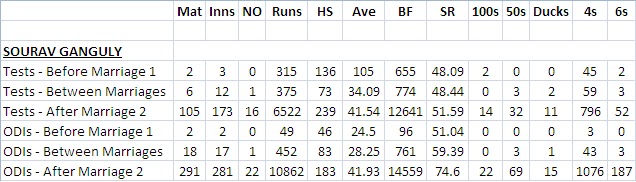
Ganguly has two marriage dates. The first one (August 12, 1996) was when he eloped with his love, now his wife Dona Ganguly, and had his marriage registered in the government records. The second one (February 21, 1997) is the date when he reportedly celebrates his marriage anniversary as he was remarried to Dona Ganguly on that day with the consent of both their families. True Bollywood style, man! More on that later on this blog...
On another note, I am sorry bowlers... but if you want I'll do a similar research sometime later for you guys! This marriage series will continue as and when I get the time...
Sachin Tendulkar married in 1995, scored a record number of runs in 1996 World Cup and raised that form in 1998-99. He maintained his good form till 2003-04 before injuries finally caught up with him and had a toll on his body. So the lady luck supported him well for almost a decade before he faced major challenges that it could not counter!
Dravid married in the midst of his golden days. His marriage in 2003 was followed by his most memorable performance in India's tour of Australia 2003-04... the one series for which he will forever be remembered. He was soon handed the captaincy of the side and led India to Test series wins in England and West Indies. The interesting thing here is his strike rate. There was a good jump in his strike rate in both forms (particularly ODIs) after the marriage. In fact, it gave a boost to his 6-hitting capabilities. So his lady luck carried him to a captaincy stint with Team India and held him well for about 4 years till the disastrous World Cup 2007 campaign.
Viru married in 2004... just after hitting his 309. He followed it up with a couple of successful seasons before his form deserted him and he was dropped from the side. But he came back stronger after that... another 300... then almost another 300... and now he is indispensable to the team. What's unique here is that he is scoring much faster while taking lesser risks! His 6-hitting in Tests has reduced marginally... but the runs are coming faster than ever! The bowlers might start cursing the day when he got married. More than anyone else, Sir Alex Fergusson's theory fits Viru pretty well. Better results with lesser risks!
VVS Laxman is the only guy to whom marriage life has not been good (professionally, I mean)! It almost signalled the end of his ODI career... and has not done anything ti improve his Test performances. Maybe, the only positive is that he has atleast maintained his place in the Test side... which is no mean feat considering the policies of our selectors over the past few years with regard to our seniors.
Coming back to Ganguly, here are his stats:
Ganguly's marriage made his career. From a nobody... he became one of India's finest captains, had a glorious career and came to be regarded as one of the legends in Indian cricket. That is what you call Lady Luck! The Prince of Kolkata had it! His performances were wretched during the period of uncertainty over his family's acceptance of marriage... but once that was out of his way, there was not looking back for him!
So, I guess its time for guys like MS Dhoni, Yuvraj Singh and Gautam Gambhir to look at the option of marriage seriously. Who knows how it might transform their career (for the better)!
Thursday, July 1, 2010
SACHIN TENDULKAR > RICKY PONTING
Australia have a win... They restore some of their "pride"! Captain Ponting and vice - captain Clarke get 90s. And as the Cricinfo commentary put aptly... Clarke did not manage to reach his 100 since he became a victim of his own inabilities to play the big shots.
During his innings of 92, Ricky Ponting became just the 3rd batsman in One Day International cricket to cross the landmark of 13000 runs (after Sachin Tendulkar and Sanath Jaisuriya). Great achievement, that!
However, over the past few years, Ponting's form (especially in Tests) has gone down. He is no longer the feared No. 3 player that he used to be in his prime... the early 2000s. In fact, ever since he crossed the landmark of 10000 ODI runs, Ponting's Test average has been less than 50. So I thought that I will do this little comparison of how the progression through ODI landmarks has affected the Test form of the two great champion batsmen of our times... Sachin Tendulkar and Ricky Ponting.
SACHIN TENDULKAR:
10K to 11K ODI runs - 7 Tests, 699 runs @ 69.90 (2 100s, 4 50s)
11K to 12K ODI runs - 16 Tests, 1392 runs @ 54.20 (4 100s, 5 50s)
12K to 13K ODI runs - 6 Tests, 454 runs @ 50.44 (1 100, 2 50s)
13K to 14K ODI runs - 18 Tests, 1121 runs @ 48.73 (3 100s, 4 50s)
14K to 15K ODI runs - 8 Tests, 536 runs @ 44.66 (2 100s, 2 50s)
15K to 16K ODI runs - 9 Tests, 860 runs @ 57.33 (2 100s, 6 50s)
16K to 17K ODI runs - 13 Tests, 991 runs @ 45.04 (3 100s, 4 50s)
17K to 17598 ODI runs - 7 Tests, 674 runs @ 84.25 (5 100s, 1 50)
RICKY PONTING:
10K to 11K ODI runs - 6 Tests, 408 runs @ 45.33 (1 100, 3 50s)
11K to 12K ODI runs - 20 Tests, 1569 runs @ 43.58 (4 100s, 9 50s)
12K to 13K ODI runs - 8 Tests, 583 runs @ 44.84 (1 100, 3 50s)
So, from the mark of 10000 ODI runs to his current peak of 17598, Sachin Tendulkar has been able to maintain a very decent form... his average dropping below 50 only in 3 such stretches and just once below 45. Two of such occasion (13K to 14K and 14K to 15K) coincided with his injury troubles... back, fingers, tennis elbow, et cetera.
11K to 12K ODI runs - 16 Tests, 1392 runs @ 54.20 (4 100s, 5 50s)
12K to 13K ODI runs - 6 Tests, 454 runs @ 50.44 (1 100, 2 50s)
13K to 14K ODI runs - 18 Tests, 1121 runs @ 48.73 (3 100s, 4 50s)
14K to 15K ODI runs - 8 Tests, 536 runs @ 44.66 (2 100s, 2 50s)
15K to 16K ODI runs - 9 Tests, 860 runs @ 57.33 (2 100s, 6 50s)
16K to 17K ODI runs - 13 Tests, 991 runs @ 45.04 (3 100s, 4 50s)
17K to 17598 ODI runs - 7 Tests, 674 runs @ 84.25 (5 100s, 1 50)
RICKY PONTING:
10K to 11K ODI runs - 6 Tests, 408 runs @ 45.33 (1 100, 3 50s)
11K to 12K ODI runs - 20 Tests, 1569 runs @ 43.58 (4 100s, 9 50s)
12K to 13K ODI runs - 8 Tests, 583 runs @ 44.84 (1 100, 3 50s)
So, from the mark of 10000 ODI runs to his current peak of 17598, Sachin Tendulkar has been able to maintain a very decent form... his average dropping below 50 only in 3 such stretches and just once below 45. Two of such occasion (13K to 14K and 14K to 15K) coincided with his injury troubles... back, fingers, tennis elbow, et cetera.
On the other hand, Ponting's Test form has just gone southwards ever since he crossed the 10000 landmark in ODIs during the World Cup 2007. His average has never been above 50... and just once has bettered 45. His troubles have coincided more with Australia's lack of domination in cricket rather than any injury troubles of his own. His troubles, curiously, started with the retirements of Shane Warne and Glenn McGrath. Or not so curious, is it?
I have been of the belief for a long time now that Ricky Ponting's good performances with the bat have come on the back of the knowledge that his team has great batsmen in the lineup to follow him and bowlers to skittle out or who've already skittled out the opposition for a meagre total. In such a context, Sachin Tendulkar's knocks, particularly during the first half of his career, have come when he's been the lone fighter for India. Complete dependency creates additional pressure. Ponting has succumbed to it more often than not. Tendulkar has not.
Such statistics and numbers sometimes make me marvel at the contributions of guys like Brian Lara and Shivnarine Chanderpaul... the lone fighters in West Indies squads for many long years. Nevertheless, as this post is basically a comparison of SRT and RTP, I guess my choice is clear!
Wednesday, June 30, 2010
TWO CHAMPIONS... SIMILAR STORIES...
Australia have managed a decent 290 - 5 in their 50 overs in the dead rubber (oh sorry, what was it... "playing for pride") 4th ODI at The Kennington Oval, London. Just a little less than 6 miles to the south west, Roger Federer has just been handed his 2nd straight Quarter Final exit from a Tennis Grand Slam event at the Wimbledon by Czech Tomas Berdych 6-4, 3-6, 6-1, 6-4.
It just rings a bell in my head. Two champions... both losing their aura... both signalling the end of an era! Australia dominated cricket through the 1990s and the 2000s. The decade to come looks like a different story! England have been consistently performing well in the longer version of the game and have shown good form over the last 2 years in the shorter versions as well. India have been consistent, ranked No. 1 and 2 in Tests and ODIs respectively. And then there is South Africa, who play well throughout the year except for the business end of ICC tournaments.
In case of Roger Federer... he reached the semi-finals of 23 straight Grand Slam events. With the highest number of Men's Singles Grand Slam titles ever and numerous other records in his bag, he is widely acknowledged as the best Men's Tennis player ever. Through the later part of his career, his one biggest challenge was Spaniard Rafael Nadal. However, now he has been challenged by others as well... Serbian Novak Djokovic (Australian Open 2008), Argentine Juan Martin Del Potro (US Open 2009), Swede Robin Soderling (French Open 2010) and now Czech Tomas Berdych (Wimbledon 2010).
This does mean that the two sports should now become more interesting as the teams / players are more evenly matched and no particular team / player radiates an aura of invincibility. Waiting to see how my prediction pans out...
It just rings a bell in my head. Two champions... both losing their aura... both signalling the end of an era! Australia dominated cricket through the 1990s and the 2000s. The decade to come looks like a different story! England have been consistently performing well in the longer version of the game and have shown good form over the last 2 years in the shorter versions as well. India have been consistent, ranked No. 1 and 2 in Tests and ODIs respectively. And then there is South Africa, who play well throughout the year except for the business end of ICC tournaments.
In case of Roger Federer... he reached the semi-finals of 23 straight Grand Slam events. With the highest number of Men's Singles Grand Slam titles ever and numerous other records in his bag, he is widely acknowledged as the best Men's Tennis player ever. Through the later part of his career, his one biggest challenge was Spaniard Rafael Nadal. However, now he has been challenged by others as well... Serbian Novak Djokovic (Australian Open 2008), Argentine Juan Martin Del Potro (US Open 2009), Swede Robin Soderling (French Open 2010) and now Czech Tomas Berdych (Wimbledon 2010).
This does mean that the two sports should now become more interesting as the teams / players are more evenly matched and no particular team / player radiates an aura of invincibility. Waiting to see how my prediction pans out...
Saturday, June 12, 2010
SUGGESTIONS TO CRICKET AUSTRALIA
Cricket Australia's news that it will be staging a new format of List 'A' cricket by splitting one 50-over innings into two 20-25 over innings has attracted a lot of comments and blogs on the blogosphere. Well, I have a few suggestions...
I have had these suggestions ever since Sachin Tendulkar made the comment that ODIs should be split into 2 innings of 25 overs each. If an official from Cricket Australia ever stumbles upon this blog, you may want to try out some of these suggestions, mate!
Suggestion No. 1: Allow new balls for 2nd innings -
In ODI cricket, the balls are changed after 34 overs and newer 'old' balls are brought in to replace the used ones. Instead, I would like to see 'new' balls used at the start of 2nd innings. This will allow pace bowlers a chance to get more purchase from lifeless pitches, and for batsmen, it will mean better pace on the ball on slower pitches. But this suggestion makes more sense when you read my Suggestion No. 2...
Suggestion No. 2: Allow different batsmen to resume the 2nd innings -
There are talks that the 2nd batting innings will be resumed exactly where the 1st one ended. I have a different opinion. Let the score remain as it was. If Team A was 140-2 in 25 overs, they will resume at that score. But if the team does not want to resume with the batsmen who were unbeaten at the end of the 1st innings, it should be allowed to change. The unbeaten batsmen can be qualified as retired and can come in some other time later during the 2nd innings.
Coupled with the earlier suggestion, it brings a whole new set of strategies in place. Should you go in with 2 sets of openers? Should the middle order be shortened? Where to play your slog over specialists? In fact, the concept of slog overs itself may see a change. To those who think that the idea of two sets of openers is insane, read on the next suggestion...
Suggestion No. 3: Allow all bowlers a maximum of 12 overs -
I heard suggestions somewhere that 2 bowlers should be allowed to bowl a maximum if 12 overs in an ODI. My question is: why stop at 2 bowlers? Why are we so miserly when we want to create rules that favour bowlers? Allowing 4 bowlers a quota of 12 overs (assuming a 50-over game) means that only 2 overs have to be managed out of your part timers. And if your regular bowlers are taking a beating, it will pay to have a genuine all-rounder.
Now, how does this compliment my Suggestion No. 2? If both the suggestions are implemented, then teams can go in with 3 genuine bowlers, 2 decent all rounders, 1 wicketkeeper, 4 openers and 1 solid middle order batsmen / another all rounder / bits-n-pieces player. There will be a lot more scope for flexibility if teams do not opt for 4 openers. They may even want to go for 3 openers and open the 2nd innings with the 3rd opener and one of the unbeaten well set batsmen.
There is a lot of scope for new strategies and there will be a need to change the laws relating to Powerplays as well as Duckworth - Lewis Method. A lot will need to be done. My suggestions might not go down well with everyone and I'd be delighted to read my readers' views on the same. I, for one, definitely feel, that it might just help One Day cricket survive.
I have had these suggestions ever since Sachin Tendulkar made the comment that ODIs should be split into 2 innings of 25 overs each. If an official from Cricket Australia ever stumbles upon this blog, you may want to try out some of these suggestions, mate!
Suggestion No. 1: Allow new balls for 2nd innings -
In ODI cricket, the balls are changed after 34 overs and newer 'old' balls are brought in to replace the used ones. Instead, I would like to see 'new' balls used at the start of 2nd innings. This will allow pace bowlers a chance to get more purchase from lifeless pitches, and for batsmen, it will mean better pace on the ball on slower pitches. But this suggestion makes more sense when you read my Suggestion No. 2...
Suggestion No. 2: Allow different batsmen to resume the 2nd innings -
There are talks that the 2nd batting innings will be resumed exactly where the 1st one ended. I have a different opinion. Let the score remain as it was. If Team A was 140-2 in 25 overs, they will resume at that score. But if the team does not want to resume with the batsmen who were unbeaten at the end of the 1st innings, it should be allowed to change. The unbeaten batsmen can be qualified as retired and can come in some other time later during the 2nd innings.
Coupled with the earlier suggestion, it brings a whole new set of strategies in place. Should you go in with 2 sets of openers? Should the middle order be shortened? Where to play your slog over specialists? In fact, the concept of slog overs itself may see a change. To those who think that the idea of two sets of openers is insane, read on the next suggestion...
Suggestion No. 3: Allow all bowlers a maximum of 12 overs -
I heard suggestions somewhere that 2 bowlers should be allowed to bowl a maximum if 12 overs in an ODI. My question is: why stop at 2 bowlers? Why are we so miserly when we want to create rules that favour bowlers? Allowing 4 bowlers a quota of 12 overs (assuming a 50-over game) means that only 2 overs have to be managed out of your part timers. And if your regular bowlers are taking a beating, it will pay to have a genuine all-rounder.
Now, how does this compliment my Suggestion No. 2? If both the suggestions are implemented, then teams can go in with 3 genuine bowlers, 2 decent all rounders, 1 wicketkeeper, 4 openers and 1 solid middle order batsmen / another all rounder / bits-n-pieces player. There will be a lot more scope for flexibility if teams do not opt for 4 openers. They may even want to go for 3 openers and open the 2nd innings with the 3rd opener and one of the unbeaten well set batsmen.
There is a lot of scope for new strategies and there will be a need to change the laws relating to Powerplays as well as Duckworth - Lewis Method. A lot will need to be done. My suggestions might not go down well with everyone and I'd be delighted to read my readers' views on the same. I, for one, definitely feel, that it might just help One Day cricket survive.
Wednesday, June 2, 2010
NO INDIA IN ASIAN GAMES... SO WHAT? - PART 2
The cricket that will be played at the Asian Games will be Twenty20 format. There will be a Champions League Twenty20 to be played just before that. There will be IPL every year. There will be a Twenty20 World Cup every two years. If cricket is included in the Olympics and the Commonwealth Games, there will be more such Twenty20 tournaments. Then there will be the ODI World Cups and the Champions Trophies. Where is the space for Tests then? Where is the time for bilateral tours?
The second allegation being made is regarding the politics involved in governance of Indian sport. This one does make some sense. A very pertinent question raised last night in a news debate regarding this issue was: if the men's schedule is too tight to not send a full-strength team, why can't the BCCI send the women's team atleast? Is it because the BCCI does not want the team to play under the banner of the Indian Olympic Association (IOA), which is governed by Mr. Suresh Kalmadi (who is not on the best of terms with a certain Mr. Sharad Pawar)?
If this is true, it is a shame! Sport in the sub-continent has always been riddled with politics. BCCI could also have sent a second-string side for the men's event as well. They may say that our secon-string side would not have won a gold, but that does not qualify as an arguement. Sending a strong side also does not assure you of gold either.
I have no clue as to what might happen now. Maybe the BCCI will buckle under the pressure from the Sports Ministry or something and decide to send a team. Maybe a second-string team will be sent. Maybe a women's team will be sent. Maybe the New Zealand tour will be shifted to cramp the cricket calender even more. Maybe the 3-Test 5-ODI tour will be shortened to a 2-Test 3-ODI tour. God only knows. But in the interest of the game, all I have to say is that don't just slam the BCCI for the sake of it.
I am no fan of the Board of Control for Cricket in India... but they do have a job. And in every job, at certain times, you are helpless. That is BCCI's state at the moment. Lets just give them some space to make a decision and then respect it if they can give sound logic behind their decision.
The second allegation being made is regarding the politics involved in governance of Indian sport. This one does make some sense. A very pertinent question raised last night in a news debate regarding this issue was: if the men's schedule is too tight to not send a full-strength team, why can't the BCCI send the women's team atleast? Is it because the BCCI does not want the team to play under the banner of the Indian Olympic Association (IOA), which is governed by Mr. Suresh Kalmadi (who is not on the best of terms with a certain Mr. Sharad Pawar)?
If this is true, it is a shame! Sport in the sub-continent has always been riddled with politics. BCCI could also have sent a second-string side for the men's event as well. They may say that our secon-string side would not have won a gold, but that does not qualify as an arguement. Sending a strong side also does not assure you of gold either.
I have no clue as to what might happen now. Maybe the BCCI will buckle under the pressure from the Sports Ministry or something and decide to send a team. Maybe a second-string team will be sent. Maybe a women's team will be sent. Maybe the New Zealand tour will be shifted to cramp the cricket calender even more. Maybe the 3-Test 5-ODI tour will be shortened to a 2-Test 3-ODI tour. God only knows. But in the interest of the game, all I have to say is that don't just slam the BCCI for the sake of it.
I am no fan of the Board of Control for Cricket in India... but they do have a job. And in every job, at certain times, you are helpless. That is BCCI's state at the moment. Lets just give them some space to make a decision and then respect it if they can give sound logic behind their decision.
NO INDIA IN ASIAN GAMES... SO WHAT? - PART 1
Last night, most of the news channels that I saw were showing just one news - BCCI has decided against sending a team to the Asian Games later this year in November at Guangzhou, China.
What amused me was the fact that this news has generated a lot of ire against the BCCI. While the media being against the BCCI is not a new occurence, but the reasons given certainly left me puzzled.
Why is BCCI not sending a team to the Asian Games? What is the BCCI's take on it?
As per the Future Tours Program, India is supposed to host New Zealand for a Test and ODI bilateral series during that period. Considering that India will also be hosting Australia for 7 ODIs (it may change to include Tests as well) just before the New Zealand tour and will tour South Africa immediately after the New Zealand tour, there is just no space to reschedule the tour.
What are the allegations against the BCCI made by the media?
The first allegation that is being made is that BCCI is a money-thirsty animal, and sees no profit in sending the team to China for the Asian Games. The news channels have gone to the extent of saying that BCCI feels no pride in sending an Indian team and just wants more of IPL and the money.
Loads of blasphemy! I guess that BCCI bashing has become an obsession with the Indian media. There may be no money in sending a team to the Asian Games... but then there isn't a lot of money in hosting New Zealand either. Infact, considering that the Asian Games would have meant more of Twenty20, it might just have generated more money than Tests and ODIs with New Zealand.
And even against New Zealand, we will see an Indian outfit... not an IPL club. They will still be playing for the pride of representing India, whether its against New Zealand or whether its in China. So the media men should get a hold of themselves while alleging that there is no pride left in representing India.
And what pride will be earned by beating Oman, Afghanistan, UAE and China to earn an Asian Games medal? Wouldn't the national pride be better served by beating New Zealand in Tests and ODIs... try and retain the No. 1 ranking in Tests and get to the No. 1 in ODIs?
(contd...)
What amused me was the fact that this news has generated a lot of ire against the BCCI. While the media being against the BCCI is not a new occurence, but the reasons given certainly left me puzzled.
Why is BCCI not sending a team to the Asian Games? What is the BCCI's take on it?
As per the Future Tours Program, India is supposed to host New Zealand for a Test and ODI bilateral series during that period. Considering that India will also be hosting Australia for 7 ODIs (it may change to include Tests as well) just before the New Zealand tour and will tour South Africa immediately after the New Zealand tour, there is just no space to reschedule the tour.
What are the allegations against the BCCI made by the media?
The first allegation that is being made is that BCCI is a money-thirsty animal, and sees no profit in sending the team to China for the Asian Games. The news channels have gone to the extent of saying that BCCI feels no pride in sending an Indian team and just wants more of IPL and the money.
Loads of blasphemy! I guess that BCCI bashing has become an obsession with the Indian media. There may be no money in sending a team to the Asian Games... but then there isn't a lot of money in hosting New Zealand either. Infact, considering that the Asian Games would have meant more of Twenty20, it might just have generated more money than Tests and ODIs with New Zealand.
And even against New Zealand, we will see an Indian outfit... not an IPL club. They will still be playing for the pride of representing India, whether its against New Zealand or whether its in China. So the media men should get a hold of themselves while alleging that there is no pride left in representing India.
And what pride will be earned by beating Oman, Afghanistan, UAE and China to earn an Asian Games medal? Wouldn't the national pride be better served by beating New Zealand in Tests and ODIs... try and retain the No. 1 ranking in Tests and get to the No. 1 in ODIs?
(contd...)
Subscribe to:
Posts (Atom)